Random fact #54 - My daughter was almost named Carson after this fine author, Carson McCullers. Carson has a great essay about her writing & creative process online.
Here's a sample and you can click on the link below to read the whole thing--
When work does not go well, no life is more miserable than that of a writer. But when it does go well, when the illumination has focused a work so that it goes limpidly and flows, there is no gladness like it.
Why does one write? Truly it is financially the most ill-rewarded occupation in the world. My lawyer has figured out how much I made from the book The Member of the Wedding, and it is, over the five years I worked on it, twenty-eight cents a day. Then the irony is, the play The Member of the Wedding had made so much money that I've had to give eighty per cent to the government — which I'm happy, or at least have to be happy, to do.
It must be that one writes from some subconscious need for communication, for self-expression. Writing is a wandering, dreaming occupation. The intellect is submerged beneath the unconscious the thinking mind is best controlled by the imagination. Yet writing is not utterly amorphous and unintellectual. Some of the best novels and prose are as exact as a telephone number, but few prose writers can achieve this because of the refinement of passion and poetry that is necessary. I don't like the word prose; it's too prosaic. Good prose should be fused with the light of poetry; prose should be like poetry, poetry should make sense like prose.
--- Carson McCullers from The Flowering Dream, Esquire, 1959
*
Showing posts with label writing life. Show all posts
Showing posts with label writing life. Show all posts
Wednesday, February 04, 2009
Wednesday, January 21, 2009
The Inaugural Poem - Elizabeth Alexander
I've been asked quite a few times over the last two days my opinion of Elizabeth Alexander's poem and "was it good enough?" Was she good enough?
Yesterday, a poet read a poem she had written for an occasion that will never happen again. An occasion of firsts and of history. An occasion where she was to speak the words she wrote just moments after Barack Obama had been sworn in as president, after he made his first speech.
After a speech by the 82% public approval, newly-sworn-in, change-is-happening-now, we've-made-it-to-that-day, now President Barack Obama--would anything be good enough.
In the moment, listening to the poem, I was nervous. Nervous for Elizabeth Alexander (I so hate live TV as I always worry someone will mess up...). Nervous that others would like the poem and worried that a poet wouldn't be asked back. It was hard for me to enjoy it at the moment, it was hard not to wrap my heart up and carry it into the other room for safe keeping--a poet reading a poem on such an occasion--I wasn't used to this kind of spotlight, but I listened
and certain lines stood out to me--
walking past each other, catching each other's
eyes or not, about to speak or speaking.
noise and bramble, thorn and din, each
one of our ancestors on our tongues.
A teacher says, Take out your pencils. Begin.
We encounter each other in words, words...
Say it plain: that many have died for this day.
What if the mightiest word is love?
On the brink, on the brim, on the cusp,
praise song for walking forward in that light.
I went back and watched her read it again on YouTube. I read it again on Peter's blog.
How can I take a moment like this and criticize any aspect of it? It's too new, it's too important. I'm too grateful-- a poet (a poet!) was included again and not someone that everyone knew, including everyone in the poetry world. How can I say "she should have done this..." after it's already happened?
Speaking the poem is a moment--on a freezing January day to millions of people, even more home watching it on television, on the stage with a new president in a historic moment after he had just spoken to America and the world for the first time as our new leader. I can't say anything except in gratitude for Elizabeth Alexander for stepping up to the podium and reading her poem. In gratitude to Barack Obama for once again including a poet in the ceremonies. Gratitude for poetry to stand on the world stage with musicians, politics, singers, prayer, and our new president and his family.
Do I like the poem?
We encounter each other in words, words...
Do I think she did a good job?
On the brink, on the brim, on the cusp,
praise song for walking forward in that light.
I've ordered my copy from Graywolf. I feel honored by this day.
*
Yesterday, a poet read a poem she had written for an occasion that will never happen again. An occasion of firsts and of history. An occasion where she was to speak the words she wrote just moments after Barack Obama had been sworn in as president, after he made his first speech.
After a speech by the 82% public approval, newly-sworn-in, change-is-happening-now, we've-made-it-to-that-day, now President Barack Obama--would anything be good enough.
In the moment, listening to the poem, I was nervous. Nervous for Elizabeth Alexander (I so hate live TV as I always worry someone will mess up...). Nervous that others would like the poem and worried that a poet wouldn't be asked back. It was hard for me to enjoy it at the moment, it was hard not to wrap my heart up and carry it into the other room for safe keeping--a poet reading a poem on such an occasion--I wasn't used to this kind of spotlight, but I listened
and certain lines stood out to me--
walking past each other, catching each other's
eyes or not, about to speak or speaking.
noise and bramble, thorn and din, each
one of our ancestors on our tongues.
A teacher says, Take out your pencils. Begin.
We encounter each other in words, words...
Say it plain: that many have died for this day.
What if the mightiest word is love?
On the brink, on the brim, on the cusp,
praise song for walking forward in that light.
I went back and watched her read it again on YouTube. I read it again on Peter's blog.
How can I take a moment like this and criticize any aspect of it? It's too new, it's too important. I'm too grateful-- a poet (a poet!) was included again and not someone that everyone knew, including everyone in the poetry world. How can I say "she should have done this..." after it's already happened?
Speaking the poem is a moment--on a freezing January day to millions of people, even more home watching it on television, on the stage with a new president in a historic moment after he had just spoken to America and the world for the first time as our new leader. I can't say anything except in gratitude for Elizabeth Alexander for stepping up to the podium and reading her poem. In gratitude to Barack Obama for once again including a poet in the ceremonies. Gratitude for poetry to stand on the world stage with musicians, politics, singers, prayer, and our new president and his family.
Do I like the poem?
We encounter each other in words, words...
Do I think she did a good job?
On the brink, on the brim, on the cusp,
praise song for walking forward in that light.
I've ordered my copy from Graywolf. I feel honored by this day.
*

Saturday, January 03, 2009
CRiPeS! 771 unread messages...
-
This is the untold story about a poet who doesn't like submitting so much that she decides to not read her emails on places to submit for almost a year and finds herself with 771 unread emails, hilarity ensues.
I think last year was my worst year for submitting poems. Yes, I submitted my work, but haphazardly, occasionally, whenever it caught my whim. But mostly, I ignored all Creative Writing Opportunities and literally, my CRWROPPS email folder had 771 UNREAD messages. 771. That's 771 opportunities I ignored.
(By the way, for those of you who don't know, CRWOPPS is listserv run by Allison Joseph that posts call for submissions-and now even academic jobs-for writers and poets. You can sign up on Yahoo by going here-- http://groups.yahoo.com/group/CRWROPPS-B/ -- the first list had issues, so it's the CRWROPPS-B list to sign up for... It's a great service to writers, but only when you actually READ the emails - imagine.)
But now back to my story of 771 unread messages...
I'll tell you how it began (as all bad habits do), I became busy and didn't read my CRWOPPS folder and inside were 25 or so unread messages. I told myself I'd find some time to do that, but didn't. A few days later, there 29 then 36 then 43, then the task of reading these emails seemed too big, as it seemed I needed a good chunk of time to read them. But I never took that chunk of time, or any chunk of time and the emails grew and grew...like the person who stores one pizza box in the corner, than another and another, I was my own type of packrat never getting to my now Creative Writing Opportunities mess that was stacking up.
With the fear of not wanting to miss any opportunity, I didn't delete them thinking I'd get to them. I didn't. And the number of unread emails grew -100, 240... By then it had just become a lesson in ignoring, I knew I wasn't going to get to it, but instead of jumping back and just catching up on a little like all good procrastinators, I said no, I'll find time.
Now here we are 8 months later. Yes, I didn't read CRWOPPS from April through December 2008. WTF? I know exactly what I was thinking--I'll get to it. But it never became a priority and because I could still get by without it (submitting to journals only and not anthologies, not submitting to "theme" issues, submitting to places my poet-friends emailed me with notes saying, "I saw this and thought of you..." -thank you, btw). And I did. The path of least resistance.
But looking back as I go through and delete/clean up these unread emails, I see I missed a lot of good opportunities for issues and anthologies I have poems for. Am I bummed? Yes, but I'm not going to kick myself over it (well, maybe a little), what I'm going to start fresh for 2009. I now have 0 unread messages in my CRWOPPS inbox and will not let the dishes stack up in the sink or the pizza boxes pile to the ceiling this year.
My thoughts on all of this--
1) New beginnings do not have to start just in January...I could have easily cleaned out my CRWOPPS box for fall or the beginning of any month. Summary-- You can always start over. Every day is a chance for a new beginning.
2) It's better to do a little (even if it feels like it's nothing) than to do nothing. A little of anything will get you farther any day than a lot of nothing.
3) Figure out why you are avoiding a task. (Or don't figure out, assume you are avoiding a task because it's easier not to do it, seriously, it's that really the reason we avoid tasks? Then do the task anyway.) For me, the convenience and ease of ignoring was worth more to me than the time of having to sort through hundreds of unread emails and the uncomfortableness I knew I'd feel when I saw all the opportunities I missed.
4) Forgive yourself and move on. We all muck up. If we didn't, we wouldn't be interesting people. There are worse crimes in the world than _____________________ (fill in the blank) in my case - "ignoring CRWOPPS for 8 months"). We are imperfect lovable annoying people. We do things that are bad for us even when we know we shouldn't. That's life. It's short, forgive, move on, don't do it again.
My plan so this doesn't happen again? I've added it to my PalmPilot to do list and I have a group of writer/poet friends who will keep me accountable each week to do at least one submission. Most things are easier if you do them in small tasks, so my goal- one submission a week. And if I get more than 25 unread emails, I have one day to read them or delete them, no ignoring them, but I *hope* not to get to that point. Sheesh.
So that's the story of the poet who didn't read her emails.
*
You may now return to your lives already in progress
-
This is the untold story about a poet who doesn't like submitting so much that she decides to not read her emails on places to submit for almost a year and finds herself with 771 unread emails, hilarity ensues.
I think last year was my worst year for submitting poems. Yes, I submitted my work, but haphazardly, occasionally, whenever it caught my whim. But mostly, I ignored all Creative Writing Opportunities and literally, my CRWROPPS email folder had 771 UNREAD messages. 771. That's 771 opportunities I ignored.
(By the way, for those of you who don't know, CRWOPPS is listserv run by Allison Joseph that posts call for submissions-and now even academic jobs-for writers and poets. You can sign up on Yahoo by going here-- http://groups.yahoo.com/group/CRWROPPS-B/ -- the first list had issues, so it's the CRWROPPS-B list to sign up for... It's a great service to writers, but only when you actually READ the emails - imagine.)
But now back to my story of 771 unread messages...
I'll tell you how it began (as all bad habits do), I became busy and didn't read my CRWOPPS folder and inside were 25 or so unread messages. I told myself I'd find some time to do that, but didn't. A few days later, there 29 then 36 then 43, then the task of reading these emails seemed too big, as it seemed I needed a good chunk of time to read them. But I never took that chunk of time, or any chunk of time and the emails grew and grew...like the person who stores one pizza box in the corner, than another and another, I was my own type of packrat never getting to my now Creative Writing Opportunities mess that was stacking up.
With the fear of not wanting to miss any opportunity, I didn't delete them thinking I'd get to them. I didn't. And the number of unread emails grew -100, 240... By then it had just become a lesson in ignoring, I knew I wasn't going to get to it, but instead of jumping back and just catching up on a little like all good procrastinators, I said no, I'll find time.
Now here we are 8 months later. Yes, I didn't read CRWOPPS from April through December 2008. WTF? I know exactly what I was thinking--I'll get to it. But it never became a priority and because I could still get by without it (submitting to journals only and not anthologies, not submitting to "theme" issues, submitting to places my poet-friends emailed me with notes saying, "I saw this and thought of you..." -thank you, btw). And I did. The path of least resistance.
But looking back as I go through and delete/clean up these unread emails, I see I missed a lot of good opportunities for issues and anthologies I have poems for. Am I bummed? Yes, but I'm not going to kick myself over it (well, maybe a little), what I'm going to start fresh for 2009. I now have 0 unread messages in my CRWOPPS inbox and will not let the dishes stack up in the sink or the pizza boxes pile to the ceiling this year.
My thoughts on all of this--
1) New beginnings do not have to start just in January...I could have easily cleaned out my CRWOPPS box for fall or the beginning of any month. Summary-- You can always start over. Every day is a chance for a new beginning.
2) It's better to do a little (even if it feels like it's nothing) than to do nothing. A little of anything will get you farther any day than a lot of nothing.
3) Figure out why you are avoiding a task. (Or don't figure out, assume you are avoiding a task because it's easier not to do it, seriously, it's that really the reason we avoid tasks? Then do the task anyway.) For me, the convenience and ease of ignoring was worth more to me than the time of having to sort through hundreds of unread emails and the uncomfortableness I knew I'd feel when I saw all the opportunities I missed.
4) Forgive yourself and move on. We all muck up. If we didn't, we wouldn't be interesting people. There are worse crimes in the world than _____________________ (fill in the blank) in my case - "ignoring CRWOPPS for 8 months"). We are imperfect lovable annoying people. We do things that are bad for us even when we know we shouldn't. That's life. It's short, forgive, move on, don't do it again.
My plan so this doesn't happen again? I've added it to my PalmPilot to do list and I have a group of writer/poet friends who will keep me accountable each week to do at least one submission. Most things are easier if you do them in small tasks, so my goal- one submission a week. And if I get more than 25 unread emails, I have one day to read them or delete them, no ignoring them, but I *hope* not to get to that point. Sheesh.
So that's the story of the poet who didn't read her emails.
*
You may now return to your lives already in progress
-
Friday, January 02, 2009
It's January 2nd, do you know where your poems are?
While cleaning my desk yesterday I found poems. Yes, poems I had started then got behind on, then they slipped out of my mind and I went on to something else. I also found a folder with poems and notes on revising them from my workshop group.
It's both annoying and exciting to find these new/old poems. Part of me thinks, Be a little more organized, will ya? The other part says, Yeah! A poem to revise!
I have started keeping a small notebook on my desk with the titles of the poems I am working on. This year it's the Women Artists Datebook 2009 published by Syracuse Cultural Workers and what I like about this is that I can keep track of dates when poems were born.
In my computer, I keep two folders-- In Process (where I save poems I just wrote or am revising or that I feel just aren't good enough yet) and Completed Poems (which is as you guessed, poems that are finished and ready to send out to the world).
Normally, on a writing day I open my In Process folder and sort it by date. I choose maybe 5-7 poems to open into new documents at once. I flip through these poems until I find something that interests me then begin revising. When I get tired or stuck on that poem, I flip to another. Some have asked how I can concentrate on more than one poem at once and for me, what this does is take the importance off of each of the poems. There is nothing that can stop me more than having only one poem to work on at a time. It makes that poem see too important (pronounced "im-POOOOR-tant" - with an accent).
If I haven't written in awhile and try to write a new poem, it may feel hard. However, if I allow myself to write the bad stuff along with the good, writing becomes easier because I am allowing myself to play without judgment or by putting too much importance on a piece. I do write a lot, but the majority of my "poems" never go on to become poems. They spend their life in the In Process file hoping for a good revision. And if they don't get one, they are happy there as there's a lot of first drafts with good personalities to keep them entertained.
So while I tend not to make the resolution "I will not lose poems" because honestly, I know a poem is never lost, this year, I'm interested in documenting the beginnings of poems and essays in my desk calendar. And still keeping that little index card on my desk with the titles of poems I'm working on. Sometimes I think I'm just having my own love affair/environment disaster with paper as it seems to always be surrounding me. (Side note: once in my twenties I went to a psychic who said, "I'm not sure what you will be doing in your thirties, but I see you completely surrounded by paper." ) This could be any day of my life in my 30's!
Anyway, I have mentioned my poetry process before, but someone asked, so there you go. Plus the new detail of the desk calendar, I'll tell you how this works as well as I'll end this post with a writing exercise--
* * *
Writing Exercise--
New Year's Poem
***Make a list of at least 10 specific items or images that you saw, touched, tasted, or heard on Dec 31st or January 1st. Now write down 4 things that you did either on New Year's Eve or New Year's Day.
Now write a poem that includes two of the things you did on New Year's Eve or New Year's Day as well as 6 of the items/images from your list.
Happy 2009!
It's both annoying and exciting to find these new/old poems. Part of me thinks, Be a little more organized, will ya? The other part says, Yeah! A poem to revise!
I have started keeping a small notebook on my desk with the titles of the poems I am working on. This year it's the Women Artists Datebook 2009 published by Syracuse Cultural Workers and what I like about this is that I can keep track of dates when poems were born.
In my computer, I keep two folders-- In Process (where I save poems I just wrote or am revising or that I feel just aren't good enough yet) and Completed Poems (which is as you guessed, poems that are finished and ready to send out to the world).
Normally, on a writing day I open my In Process folder and sort it by date. I choose maybe 5-7 poems to open into new documents at once. I flip through these poems until I find something that interests me then begin revising. When I get tired or stuck on that poem, I flip to another. Some have asked how I can concentrate on more than one poem at once and for me, what this does is take the importance off of each of the poems. There is nothing that can stop me more than having only one poem to work on at a time. It makes that poem see too important (pronounced "im-POOOOR-tant" - with an accent).
If I haven't written in awhile and try to write a new poem, it may feel hard. However, if I allow myself to write the bad stuff along with the good, writing becomes easier because I am allowing myself to play without judgment or by putting too much importance on a piece. I do write a lot, but the majority of my "poems" never go on to become poems. They spend their life in the In Process file hoping for a good revision. And if they don't get one, they are happy there as there's a lot of first drafts with good personalities to keep them entertained.
So while I tend not to make the resolution "I will not lose poems" because honestly, I know a poem is never lost, this year, I'm interested in documenting the beginnings of poems and essays in my desk calendar. And still keeping that little index card on my desk with the titles of poems I'm working on. Sometimes I think I'm just having my own love affair/environment disaster with paper as it seems to always be surrounding me. (Side note: once in my twenties I went to a psychic who said, "I'm not sure what you will be doing in your thirties, but I see you completely surrounded by paper." ) This could be any day of my life in my 30's!
Anyway, I have mentioned my poetry process before, but someone asked, so there you go. Plus the new detail of the desk calendar, I'll tell you how this works as well as I'll end this post with a writing exercise--
* * *
Writing Exercise--
New Year's Poem
***Make a list of at least 10 specific items or images that you saw, touched, tasted, or heard on Dec 31st or January 1st. Now write down 4 things that you did either on New Year's Eve or New Year's Day.
Now write a poem that includes two of the things you did on New Year's Eve or New Year's Day as well as 6 of the items/images from your list.
Happy 2009!
Tuesday, December 16, 2008
Flashback!
This is to the kind person who showed me how to resurrect my old blog (the one I regretted deleting). You have done your good deed for Christmas, Thank you!
Here's a post I wrote Wednesday, December 28, 2005. Three years later, I still have the same beliefs on success.
Here you go--
I've got the brains, you've got the looks, let's make lots of money...
Success--
So, there's been some blogging about success lately, what makes a successful poet. Some say that we need a book, others suggest it's the awards (NEA, Guggenheim, Pushcart). Others believe a certain list of journals we've been published in. And even if we have all these wonderful things, is that success? Most people find my blog by searching for the recipe to make a pomegranate martini. More people search for drinks and find me than in searches for poetry (and I *think* I talk about poetry more). Poets know other poets. Regular folks know Maya Angelou, sometimes Billy Collins, and sometimes Mary Oliver.
Poets are not known by most of the world. I thought about this when I felt too nervous to ask Bob Hicok to sign my book. I thought, 99.8% of the US population would *not* feel intimidated by him, yet because I write poetry, he has moved up my "important people list" and therefore making a fool of myself in front of BH as opposed to the random people I meet daily would be more painful. (I did ask him to sign my book and of course, came off socially inept as I tend to do around people I like...It's a gift.)
Anyhoo, perhaps I'm in a different camp with this success stuff because I don't think poetry can make anyone "successful." It's really hard for me to judge a person by their resume. Just as I wouldn't call a CEO successful, just because s/he is a CEO. I don't think credits, publications, and awards make a successful poet. I do think they're incredibly fun to achieve and feel rewarding, but I wouldn't base my life's success on what I achieve in poetry. (This doesn't mean stop I think we should stop submitting or trying to achieve certain goals as a poet, I think that keeps things interesting, I'm just saying at the end of the day, I don't think we'll look back on our lives and think, "I'm so glad I was published in ________." Okay, I *may* say that about the New Yorker, but that's because I can be shallow.)
Realize, this is coming from someone who has no problem beating little kids in Candyland...I like to win. But, I realize "success" can't be achieved through poetry because first, it's so subjective. I'm sure I've had poems accepted because someone was having a good day and I'm sure others were rejected because the someone had just received a traffic ticket. And we can't base it on awards, I mean, poor Emily D., where was her first book award, her Guggenheim?
And isn't it funny how poetry is a sort of erudite crack? I mean, you start out and you write a poem, and it feels satisfying. So you write another and you like that feeling, but it starts to be a bit dull, so you wander into a new neighborhood and try to publish them. You take another hit and then wham! you publish your first poem--and it feels good, really good. So you submit again, another poem in another journal and the high keeps coming back. You need more time to write more poems. You’re up late at night writing and submitting. And with each acceptance, you get your high back, but it’s not as good as the first time.
The feeling begins to wear off a little or maybe things are starting to feel "too easy," so you move from Spindrift to The Bellingham Review. You have to keep raising the bar, keep moving up the ladder to get that next great high. You submit to Prairie Schooner. You submit to the New Yorker. You submit to Poetry. You look back at the accomplishments that first made you happy, first made you feel successful and they seem small.
You publish a book and realize that even with a book, you're still yourself and you keep trying for that next high... You wake up at your desk and find yourself strung out on herbal tea covered in your own SASEs-- and there’s a bill from the post office you can’t explain. You become that disco song, "More, More, More. How you do like it? How do you like it?...." Yes, you’re addicted.
I know how happy I feel with my little poetry accomplishments, with any sort of validation that comes my way. And I do think that our publications and accomplishments as poets should be celebrated. I mean, anytime I can find a reason to have a party for myself, I do. But I do try to remind myself that my success as a poet cannot be written down on a resume, it's something greater than that.
As a poet, I guess if I had to determine how success can be measured, it would be in how much we return to others. This can be through our poems or in person, over email, with a blog, on the phone, through a class/lecture, in a letter, in our books, as an editor, as for me, a poet's success is based on his or her actions as a poet. And even if one is getting paid for any of the above, it still counts. But I guess that's how I measure the success of any person (poet or not), not by what was achieved, but what they returned, not by what they have, but what they gave.
Maybe I'm thinking too much about this, but I know the things that I base my self-worth on or my “success” are by the number of people who see me as a friend and if I'm kinder more of the time than hurtful. Mostly though, I guess I base success on how the people closest to me see me. If in the end, my family can say that I did a pretty good job in their eyes, then I made it. The rest of it is bells and whistles, the rest of it is fringe on my already stylish suede skirt.
Of course, if the New Yorker calls. . .
****And I still kick butt at Candyland!
Here's a post I wrote Wednesday, December 28, 2005. Three years later, I still have the same beliefs on success.
Here you go--
I've got the brains, you've got the looks, let's make lots of money...
Success--
So, there's been some blogging about success lately, what makes a successful poet. Some say that we need a book, others suggest it's the awards (NEA, Guggenheim, Pushcart). Others believe a certain list of journals we've been published in. And even if we have all these wonderful things, is that success? Most people find my blog by searching for the recipe to make a pomegranate martini. More people search for drinks and find me than in searches for poetry (and I *think* I talk about poetry more). Poets know other poets. Regular folks know Maya Angelou, sometimes Billy Collins, and sometimes Mary Oliver.
Poets are not known by most of the world. I thought about this when I felt too nervous to ask Bob Hicok to sign my book. I thought, 99.8% of the US population would *not* feel intimidated by him, yet because I write poetry, he has moved up my "important people list" and therefore making a fool of myself in front of BH as opposed to the random people I meet daily would be more painful. (I did ask him to sign my book and of course, came off socially inept as I tend to do around people I like...It's a gift.)
Anyhoo, perhaps I'm in a different camp with this success stuff because I don't think poetry can make anyone "successful." It's really hard for me to judge a person by their resume. Just as I wouldn't call a CEO successful, just because s/he is a CEO. I don't think credits, publications, and awards make a successful poet. I do think they're incredibly fun to achieve and feel rewarding, but I wouldn't base my life's success on what I achieve in poetry. (This doesn't mean stop I think we should stop submitting or trying to achieve certain goals as a poet, I think that keeps things interesting, I'm just saying at the end of the day, I don't think we'll look back on our lives and think, "I'm so glad I was published in ________." Okay, I *may* say that about the New Yorker, but that's because I can be shallow.)
Realize, this is coming from someone who has no problem beating little kids in Candyland...I like to win. But, I realize "success" can't be achieved through poetry because first, it's so subjective. I'm sure I've had poems accepted because someone was having a good day and I'm sure others were rejected because the someone had just received a traffic ticket. And we can't base it on awards, I mean, poor Emily D., where was her first book award, her Guggenheim?
And isn't it funny how poetry is a sort of erudite crack? I mean, you start out and you write a poem, and it feels satisfying. So you write another and you like that feeling, but it starts to be a bit dull, so you wander into a new neighborhood and try to publish them. You take another hit and then wham! you publish your first poem--and it feels good, really good. So you submit again, another poem in another journal and the high keeps coming back. You need more time to write more poems. You’re up late at night writing and submitting. And with each acceptance, you get your high back, but it’s not as good as the first time.
The feeling begins to wear off a little or maybe things are starting to feel "too easy," so you move from Spindrift to The Bellingham Review. You have to keep raising the bar, keep moving up the ladder to get that next great high. You submit to Prairie Schooner. You submit to the New Yorker. You submit to Poetry. You look back at the accomplishments that first made you happy, first made you feel successful and they seem small.
You publish a book and realize that even with a book, you're still yourself and you keep trying for that next high... You wake up at your desk and find yourself strung out on herbal tea covered in your own SASEs-- and there’s a bill from the post office you can’t explain. You become that disco song, "More, More, More. How you do like it? How do you like it?...." Yes, you’re addicted.
I know how happy I feel with my little poetry accomplishments, with any sort of validation that comes my way. And I do think that our publications and accomplishments as poets should be celebrated. I mean, anytime I can find a reason to have a party for myself, I do. But I do try to remind myself that my success as a poet cannot be written down on a resume, it's something greater than that.
As a poet, I guess if I had to determine how success can be measured, it would be in how much we return to others. This can be through our poems or in person, over email, with a blog, on the phone, through a class/lecture, in a letter, in our books, as an editor, as for me, a poet's success is based on his or her actions as a poet. And even if one is getting paid for any of the above, it still counts. But I guess that's how I measure the success of any person (poet or not), not by what was achieved, but what they returned, not by what they have, but what they gave.
Maybe I'm thinking too much about this, but I know the things that I base my self-worth on or my “success” are by the number of people who see me as a friend and if I'm kinder more of the time than hurtful. Mostly though, I guess I base success on how the people closest to me see me. If in the end, my family can say that I did a pretty good job in their eyes, then I made it. The rest of it is bells and whistles, the rest of it is fringe on my already stylish suede skirt.
Of course, if the New Yorker calls. . .
****And I still kick butt at Candyland!
Poetry Stuff
Rejections-- Kenyon Review, Rattle, Smartish Pace
Acceptances - The Smoking Poet (see post below)
Readings: Northwind Gallery anthology reading (photos from the reading here) My hair looks poufy.
Other news - I just learned my second mss is a finalist for a book contest and is in the hands of an outside unnamed judge. I don't know how many mss were named finalists, 5, 10, 20, 50? I'm not sure. But it makes me hopeful. Make a Christmas wish for me...I'd love to be chosen.
Poetry Barn - I'm using 2 space heaters to warm up the poetry barn, it's 25 degrees outside and the poetry barn is a tad drafty. I lost 3 weeks of use of my writing shed because the keyboard to my laptop broke...well, more honestly, I broke it trying to clean beneath the keys. Don't flip off keys to clean beneath them, sometimes they don't go back on and superglue makes things worse. I've had to use an external keyboard up until last week and it didn't fit on my wee desk. I'm going to make the trek out to the barn after lunch.
Other Poetry things--Just bought the poetry book All-American Poem by Matthew Dickman (APR Poetry Prize). Big book, I mean, physically wide. Good poems.
He and his brother are currently the one-two punch of poetry these days. They were both profiled in the September/October 2008 of Poets and Writers (I think that's the one with Billy Collins on the cover.) and they both received acceptances for their poetry collections in 2008. I haven't read his brother's Michael's collection (which I think comes out through Copper Canyon Press), but I like Matthew's work a lot. I haven't been really excited about a poet for a while, so this is a good feeling.
Though I can only recommend the first half of the book as I haven't read the rest. I'm enjoying this collection slowly.
*
Acceptances - The Smoking Poet (see post below)
Readings: Northwind Gallery anthology reading (photos from the reading here) My hair looks poufy.
Other news - I just learned my second mss is a finalist for a book contest and is in the hands of an outside unnamed judge. I don't know how many mss were named finalists, 5, 10, 20, 50? I'm not sure. But it makes me hopeful. Make a Christmas wish for me...I'd love to be chosen.
Poetry Barn - I'm using 2 space heaters to warm up the poetry barn, it's 25 degrees outside and the poetry barn is a tad drafty. I lost 3 weeks of use of my writing shed because the keyboard to my laptop broke...well, more honestly, I broke it trying to clean beneath the keys. Don't flip off keys to clean beneath them, sometimes they don't go back on and superglue makes things worse. I've had to use an external keyboard up until last week and it didn't fit on my wee desk. I'm going to make the trek out to the barn after lunch.
Other Poetry things--Just bought the poetry book All-American Poem by Matthew Dickman (APR Poetry Prize). Big book, I mean, physically wide. Good poems.
He and his brother are currently the one-two punch of poetry these days. They were both profiled in the September/October 2008 of Poets and Writers (I think that's the one with Billy Collins on the cover.) and they both received acceptances for their poetry collections in 2008. I haven't read his brother's Michael's collection (which I think comes out through Copper Canyon Press), but I like Matthew's work a lot. I haven't been really excited about a poet for a while, so this is a good feeling.
Though I can only recommend the first half of the book as I haven't read the rest. I'm enjoying this collection slowly.
*
Sunday, December 14, 2008
Vital Stats Follow-up ;-)
Nancy posted these questions in the comments, here's my follow up--
When did you write your first poem?
***Second grade, I think. A lot happened in 2nd grade for me with writing because we had a teacher who would have creative writing sessions for all the 2nd graders (Mrs. Cameron). She always encouraged me and I don't think she ever realized how much impact she had on my life.
Who was your audience for your earliest poems?
****My mom.
Who was your audience for your earliest poems?
***In college, me or my prof. I never thought about audience or publishing. For me, I enjoyed poetry and was thrilled with the idea of writing. I didn't start submitting regularly until I was at least 30. I wrote for 10+ years and had only submitted say 5 poems to local college journals. It just wasn't anything that was important to me.
Did your first poems rhyme, or were they formal/free verse?
***They all rhymed, though I did use some slant rhyme in this ditty entitled "Love is..."
Love is my mom, love is my dad,
love is the family that I have.
(thankfully, I did not feel the need to use rhyme there or my ending would be the ominous "love is the family that I had." What parent would like to get that creepy close.
I grew up on formal verse and nursery rhymes. I had no idea poems didn't rhyme (with the exception of a few forms like haiku, acrostics, etc.) until I was a teenager.
In college, none of my poems rhymed. I was very anti-rhyme and much more into telling a story through my poems. I did not have the terms to call it "narrative" yet. At the time, I wanted every poem to be like a specific photograph, with a place, a story, and a character or two.
Who first encouraged your writing?
***My mom and most of my early grade school teachers. In college, Linda Bierds was a major reason I ever submitted or became a poet. I started out in college as a fiction writer. I had taken one poetry class and thought it was fun, but loved fiction more. Linda B. was an incredible teacher and took poetry to a completely different level and place for me.
Who did you show your first poem(s) to?
***My parents & teachers as a child.
The other students in my poetry class at the UW. I still do not show my work to my husband until it is finished (or published). Nowadays, I only to my closest poetry friends.
Do you remember your reaction to your first time being paid for writing?
***Kind of.
Did you spend that money--and on what?
***When Rattapallax paid me, I bought vintage Czech glass Mardi Gras beads and I still wear this necklace. I've also bought a vintage green ceramic vase when I won a grant or received some money (it is the closest thing to a trophy I have).
When I won the Atlantic Monthly prize, I bought a statue of Kwan Yin for my garden. Mostly, I squirrel the money away in a writing acct for myself so I have money when cool opportunities come up--like a retreat, or the Carolyn Forche class I signed up for this spring.
When is the first time you called yourself "a poet"?
****I'm still not too comfortable with this term. I'd rather say writer. I think sometimes when people hear "poet" they imagine me with a beret and bongo drums in a black turtleneck. I think other people called me a poet before I called myself a poet.
I do remember writing "writer" on my form when entering London in 1996. That was a big step for me, esp. because at the time I was working a corporate job and very unhappy with where my life was going. It was when I made a conscious decision to change directions. Within a year, I had quit my job and moved to this small town I'm in today. One of the best things I've ever done.
When did you write your first poem?
***Second grade, I think. A lot happened in 2nd grade for me with writing because we had a teacher who would have creative writing sessions for all the 2nd graders (Mrs. Cameron). She always encouraged me and I don't think she ever realized how much impact she had on my life.
Who was your audience for your earliest poems?
****My mom.
Who was your audience for your earliest poems?
***In college, me or my prof. I never thought about audience or publishing. For me, I enjoyed poetry and was thrilled with the idea of writing. I didn't start submitting regularly until I was at least 30. I wrote for 10+ years and had only submitted say 5 poems to local college journals. It just wasn't anything that was important to me.
Did your first poems rhyme, or were they formal/free verse?
***They all rhymed, though I did use some slant rhyme in this ditty entitled "Love is..."
Love is my mom, love is my dad,
love is the family that I have.
(thankfully, I did not feel the need to use rhyme there or my ending would be the ominous "love is the family that I had." What parent would like to get that creepy close.
I grew up on formal verse and nursery rhymes. I had no idea poems didn't rhyme (with the exception of a few forms like haiku, acrostics, etc.) until I was a teenager.
In college, none of my poems rhymed. I was very anti-rhyme and much more into telling a story through my poems. I did not have the terms to call it "narrative" yet. At the time, I wanted every poem to be like a specific photograph, with a place, a story, and a character or two.
Who first encouraged your writing?
***My mom and most of my early grade school teachers. In college, Linda Bierds was a major reason I ever submitted or became a poet. I started out in college as a fiction writer. I had taken one poetry class and thought it was fun, but loved fiction more. Linda B. was an incredible teacher and took poetry to a completely different level and place for me.
Who did you show your first poem(s) to?
***My parents & teachers as a child.
The other students in my poetry class at the UW. I still do not show my work to my husband until it is finished (or published). Nowadays, I only to my closest poetry friends.
Do you remember your reaction to your first time being paid for writing?
***Kind of.
Did you spend that money--and on what?
***When Rattapallax paid me, I bought vintage Czech glass Mardi Gras beads and I still wear this necklace. I've also bought a vintage green ceramic vase when I won a grant or received some money (it is the closest thing to a trophy I have).
When I won the Atlantic Monthly prize, I bought a statue of Kwan Yin for my garden. Mostly, I squirrel the money away in a writing acct for myself so I have money when cool opportunities come up--like a retreat, or the Carolyn Forche class I signed up for this spring.
When is the first time you called yourself "a poet"?
****I'm still not too comfortable with this term. I'd rather say writer. I think sometimes when people hear "poet" they imagine me with a beret and bongo drums in a black turtleneck. I think other people called me a poet before I called myself a poet.
I do remember writing "writer" on my form when entering London in 1996. That was a big step for me, esp. because at the time I was working a corporate job and very unhappy with where my life was going. It was when I made a conscious decision to change directions. Within a year, I had quit my job and moved to this small town I'm in today. One of the best things I've ever done.
Sunday, November 30, 2008
Times Online Poetry Contest! Vote!
My friend Susan Rich has a poem in an online Poetry Competition on the TIMES ONLINE. It's a wonderful poem called "Different Places to Pray" and I think it's the best of all the poems showcased there.
Here's the first line to peak your interest:
Everywhere, everywhere she wrote; something is falling –
Anyway, it's sort of the American Idol version for poets meaning, we do the voting. And if she wins, it's $2000 Euros! A pretty nice deal.
Susan's poem was selected from about 3000 poems.
So, if you'd like to read her poem in full and help out a fellow poetry friend, go to The TIMES ONLINE to vote. You have to register, but it only takes a few minutes and once you register just go back to the webpage and you can vote for "Different Places to Pray" (you don't have to wait for them to send you a notificiation, which is what I tried to do.)
I had not heard about this contest, but wow, those Euro countries can be very good to their poets! What a nice prize!
Oh and PS you have to vote before the 5th of December.
Here's the first line to peak your interest:
Everywhere, everywhere she wrote; something is falling –
Anyway, it's sort of the American Idol version for poets meaning, we do the voting. And if she wins, it's $2000 Euros! A pretty nice deal.
Susan's poem was selected from about 3000 poems.
So, if you'd like to read her poem in full and help out a fellow poetry friend, go to The TIMES ONLINE to vote. You have to register, but it only takes a few minutes and once you register just go back to the webpage and you can vote for "Different Places to Pray" (you don't have to wait for them to send you a notificiation, which is what I tried to do.)
I had not heard about this contest, but wow, those Euro countries can be very good to their poets! What a nice prize!
Oh and PS you have to vote before the 5th of December.
Friday, September 26, 2008
What I Learned From the Mail Lady & Artist Date
What I learned on sending out your manuscript--
First, you can mail your mss at the book/manuscript rate which is $2 cheaper than first class or priority mail. Actually about $2.50 cheaper, which may make a big difference to your wallet if you're sending out a lot of manuscripts.
The big difference with media mail (book/mss) is time. It can take about 2 weeks (it becomes low low priority for them), but it can also arrive pretty quickly depending if they aren't that busy. In the end, it will save you some $$ if you can send it that way.
Priority/First Class is about $4.85 and it will get there in 2 days.
At our post office, there is one mean lady and 5 other really nice postal employees. I mail on Fridays because I know she's off.
If you have a cranky post worker, learn their off days.
* * *
Artist date-- I did my artist date today and it wasn't as horrible as I thought it would be. (I used to like these artist dates, but I've become more of the sweet hermit who wants to stay close to home.) And actually, I enjoyed myself. I parked at the post office and walked down our main street to the local gallery of local artists.
Immediately after leaving my car, I ran into a poet. I thought it was a good sign to run into another writer.
As I walked to the gallery, I noticed the asters were blooming and the co-op preschool where my daughter went began to ring it's bell (snack time!) The schoolhouse the preschool is in is one of the oldest buildings in town (the attic rumored to be haunted too) and the bell is original to the school. Each day one of the preschoolers gets the job of ringing the bell for snacktime-- a thrill for them.
At the gallery, I took notes and spent time browsing. There was one piece I really liked, a print called "Pink Lady" but part of the image was a giraffe. Giraffes have come up twice for me in 2 days on the synchronicity scale. I talked with the artist working at the gallery, a woodmaker.
I found a notebook with the artists bios and sample photos of their work. It was nice to see how people keep art in their life and have an artistic existence. It is something that I aim for in myself, to continue to keep my life creative and full of writing and art.
Afterwards, I walked back to my car at the post office and just like clockwork, another good friend, also a poet (Ronda Broatch) stepped out of her car to check her PO box. She's recently had an acceptance at a journal in Ireland. We talked for awhile trying not to block traffic and making carpool plans for our next poetry workshop.
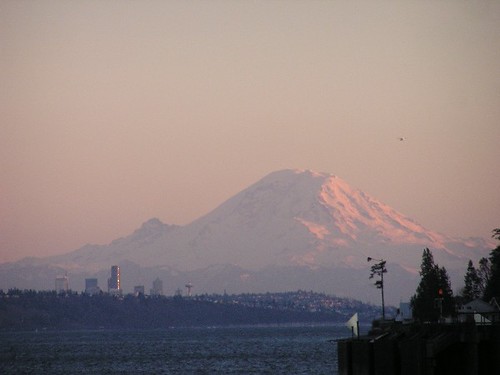
The sun had come out and I could see Mt. Rainier towering over Seattle and the tips of skyscrapers and Space Needle as I drove home. I thought I heard recently that you can only the top (or all) of Mt. Rainier only about 62 days in the year because of our foggy, cloudy weather. I don't know if that's correct, but when I do see it, it's calming and amazing to me.
As you can see reading this, it was sort of a Seinfeld episode in that nothing happened, yet everything did.
No Roses... just hope
Amy King had a thoughtful blog post about poetry contests and well, the expense of being a poet (read: poetry contests) here. It had some great links to presses as well & some open submission calls for those of you with a manuscript who want to stay away from contests.
Thursday, September 25, 2008
Thursday Thoughts---
On Writing--
I feel as if I've caught up on a lot things. I've felt behind. But I think much of it is trying to balance my own poetry, editing Crab Creek Review, and working with other poets with my regular everyday life. I have a lot going on, but I realize, for me it's best to break things up into bits (do a little of this and this), or just schedule big blocks of time, say a full day, and devote it to one project (reading someone's mss or working on my own.) As long as I'm not missing deadlines though and marking things off my To Do list, I feel pretty good.
But this brings me to my next topic--
_______________________
The Artist Way--
If you haven't heard of the The Artist Way ( The Artist's Way: A Spiritual Path to Higher Creativity) it's basically a 12 steps program for creatives. I highly recommend it if you've never done it I'm doing it for the next 12 weeks with 5 friends, all writers. The biggest hit of time is doing the morning pages (which is 3 pages of writing--which can be anything, basically it's to clear your mind...kind of what a blog does, I've noticed). But I realize, depending on my mood, I can do this between 10-30 minutes.
I also have to go on an "Artist Date" each week. 2 - 3 hours by myself, somewhere besides my house. I must say, I resist this, which must mean I need to go. I haven't had my date this week, but I will.
What I've learned already in Artist Way (and this is 4th time I've done it since 1997--also did it 2000, 2003, 2008) is that I'm not so good at saying No. Sometimes, I need to claim my own writing time. I know what I need/want to do, but I don't always necessarily do it. So I'm working on saying no.
I've heard other women have problems saying no, and I'm not just referring to the women in sexy bar clothes, but just in general, some of us tend to be nurturers--though I think I'm a little more self-indulgent, selfish, and quite open about my feelings (aka blunt) I do have a side of me that wants to help people. My dad would have called me a "do-gooder." Or maybe he would have said I need to make sure I take care of myself. Too. I think we all need to take care of ourselves.
I'll add a few updates about my Artist Way experience and what I discover.
_____________________________________________________________________________


On the Seattle Neil Diamond concert last night--
I was surprised to learn that I don't know as many of his songs as I thought, and in fact only truly love the karaoke songs (Forever in Blue Jeans, Cracklin' Rose, & Sweet Caroline). I hadn't occurred to me that Neil also sings songs I despise (Love on the Rocks, You Don't Bring Me Flowers, Play Me). About halfway through the concert, I turned to my husband and said, $@%#, he's the guy that sings "Heartlight" doesn't he?!
However, I am glad I went as it was a great time hanging out with friends (5 firefighters and their wives) and that it was the 5 firefighters who put together the evening on their own was worth it. ( I also realized last night that I don't think I could be married to anyone who wasn't a firefighter, which was kind of an odd thing to conclude, but I realized I would trust any of these guys with my life, and I can't say that about many people.) One day there may be a post or a whole essay about being married to a firefighter, but I'll save that for another day. I will add if you're a single woman, the majority of firefighters (both men and women) make good husbands/partners. Of course, they are home an awful lot... (this is both good and bad!)
***
Well, that's it from the peanut gallery today. I hope you are safe, warm, and happy.
be well.
I feel as if I've caught up on a lot things. I've felt behind. But I think much of it is trying to balance my own poetry, editing Crab Creek Review, and working with other poets with my regular everyday life. I have a lot going on, but I realize, for me it's best to break things up into bits (do a little of this and this), or just schedule big blocks of time, say a full day, and devote it to one project (reading someone's mss or working on my own.) As long as I'm not missing deadlines though and marking things off my To Do list, I feel pretty good.
But this brings me to my next topic--
_______________________
The Artist Way--
If you haven't heard of the The Artist Way ( The Artist's Way: A Spiritual Path to Higher Creativity) it's basically a 12 steps program for creatives. I highly recommend it if you've never done it I'm doing it for the next 12 weeks with 5 friends, all writers. The biggest hit of time is doing the morning pages (which is 3 pages of writing--which can be anything, basically it's to clear your mind...kind of what a blog does, I've noticed). But I realize, depending on my mood, I can do this between 10-30 minutes.
I also have to go on an "Artist Date" each week. 2 - 3 hours by myself, somewhere besides my house. I must say, I resist this, which must mean I need to go. I haven't had my date this week, but I will.
What I've learned already in Artist Way (and this is 4th time I've done it since 1997--also did it 2000, 2003, 2008) is that I'm not so good at saying No. Sometimes, I need to claim my own writing time. I know what I need/want to do, but I don't always necessarily do it. So I'm working on saying no.
I've heard other women have problems saying no, and I'm not just referring to the women in sexy bar clothes, but just in general, some of us tend to be nurturers--though I think I'm a little more self-indulgent, selfish, and quite open about my feelings (aka blunt) I do have a side of me that wants to help people. My dad would have called me a "do-gooder." Or maybe he would have said I need to make sure I take care of myself. Too. I think we all need to take care of ourselves.
I'll add a few updates about my Artist Way experience and what I discover.
_____________________________________________________________________________

On the Seattle Neil Diamond concert last night--
I was surprised to learn that I don't know as many of his songs as I thought, and in fact only truly love the karaoke songs (Forever in Blue Jeans, Cracklin' Rose, & Sweet Caroline). I hadn't occurred to me that Neil also sings songs I despise (Love on the Rocks, You Don't Bring Me Flowers, Play Me). About halfway through the concert, I turned to my husband and said, $@%#, he's the guy that sings "Heartlight" doesn't he?!
However, I am glad I went as it was a great time hanging out with friends (5 firefighters and their wives) and that it was the 5 firefighters who put together the evening on their own was worth it. ( I also realized last night that I don't think I could be married to anyone who wasn't a firefighter, which was kind of an odd thing to conclude, but I realized I would trust any of these guys with my life, and I can't say that about many people.) One day there may be a post or a whole essay about being married to a firefighter, but I'll save that for another day. I will add if you're a single woman, the majority of firefighters (both men and women) make good husbands/partners. Of course, they are home an awful lot... (this is both good and bad!)
Anyway, back to the concert--we thought we would be some of the youngest in the crowd, but we had a group of Seattle University boys behind us and I saw many younger guys who looked like a shorter and thinner versions of Ben Affleck --the Affleck look was a popular Neil Diamond fan look.
It must have been our faraway seats, but the whole night I kept thinking of Michael Dukakis when Neil sang. I think it's the eyebrows.
It must have been our faraway seats, but the whole night I kept thinking of Michael Dukakis when Neil sang. I think it's the eyebrows.
***
Well, that's it from the peanut gallery today. I hope you are safe, warm, and happy.
be well.
Friday, September 19, 2008
Catch-up, ketchup, catsup
I have been busy this week with poetry, a Garrison Keillor reading, and tightening up my mss-- lefty loosy, righty tighty..
But let's discuss the poetry reading I went to recently. As a poet and reader, I learned a lot from it. What to do at a reading and what not to do.
The poetry reading was a beautiful home on Bainbridge Island with 4 poets from UW Press -Suzanne Paola, Bruce Beasley (her husband, I learned), Christopher Howell, & John Witte, whose new book just came out. All very strong poets with big resumes and many books.
Each reader had a different style and I thought I'd talk about what I liked and what could have been improved with the reading. Because I don't want any poet to feel awkward if self-googling and finding this critique, I will discuss what I liked and disliked without naming the poet personally.
What I liked at the poetry reading -- (oh and to make things easier for my typing fingers, I refer to the poet(s) as "they" instead of him/her, etc. )
Things I liked at the poetry reading--
When poets uses humor to connect with the audience and don't take themselves too seriously.
*
When they read poems of various lengths
*
When they talk about how a poem evolved or came to be. In fact, as a poet, I love this.
*
When they talk to the audience and not above us (this is both figuratively and literally).
*
When a poet is able to mix heavier issues into the poems they read without making the audience feel as if they want to find the nearest razorblade and slit their risks. I don't think you want to depress your audience (but I do like heavier topics along with lighter ones), so even if your poems are dark or difficult, your personality does not have to be.
*
When they stay to the time limit (they *mostly* did this)
*
When they read poems that are interesting to listen to. I know that seems obviously, but some poems need time to sit with. If you read one of these poems, please help us into your poem, don't just begin without grounding us and giving us some info to help us through the poem so we don't get lost.
*
Read poems that are both lighter and ones that are a little more intense, vary the tone and the mood, and make transitions accordingly so the audience goes along with you. I love it when a poet reads a very dark poem then says, "This next poem is much happier..." and the audience laughs because they want you to stay with them.
It bothers me if someone reads a poem about a miscarriage then goes directly into a poem about a funny experience with apples because there was no transition and I'm still holding onto sadness.
*
When poets mention what book they are reading from.
*
When poets read old work and not just "the new stuff." It also sells more books.
*
When poets seems excited to be there and have an energy about them. Even if they are not energetic people, to try to bring that to reading instead of going up there with the one expression face and reading.
*
When it feels as if this is the first time they've read the poem--even if it's not, even if it's the 1000th time they've read the line, they continue to breathe life into their poem and not act tired with it. (most of the poets that read did this and I appreciate it!)
What I didn't like--
When there is no introduction of who the poet is and their work and they jump right into the poems as if we know who they are and what they are doing. Give me a little handshake before you take off your coat.
*
Reading a long long poem in the same voice, tone, and not really helping me into that poem. You will lose me if something else happens in the room (aka a jetski goes by outside on the water, the caterer brings in yummy food) and I won't be able to get back into the poem and will end up thinking about the architecture of the room, what kind of wood the beams are made of.
*
Breathe and allow the audience to breathe too. Your time is not sack to fill with stuff, but a tray to put your poems on orderly and with thoughtfulness.
*
More poems does not = a better reading.
*
Breaking a promise-- when a poet tells me they are going to read 2 more poem--actually asks if it's okay if they read two more poems (and the audience nods and says yes)--then goes on to read those 2 more poems and asks if they can read more and does so--I want to run up the mic and say "You said TWO poems..."
It's bad form and a bad habit to tell the audience one thing then go on to do something else. You have set up an expectation (hoorah, 2 more poems and I get to have appetizers!) then broken it. While many more grown-up audience members will be fine with this, there will be someone like me (who loves poetry, not sitting) who will be rolling her eyes and will not buy your book b/c you annoyed her because she has sat for 2 hours at a poetry reading and is hungry.
And then calling us "such a patient audience" does not help your cause. I did not hear that last poem anyway because I was thinking about the little chicken salsa appetizers and the peach wrapped in prosciutto and basil.
*
Do not think you are interesting just because you are a) on stage b) a poet. *Be* interesting, doesn't assume it comes with the package. Oh and interesting poems can be made uninteresting if you read them that way.
*
Don't be so hard to find after the reading. There are people who may have bought your book and are looking for you.
Actually, the press should have said something about this, where to find the poets to sign books afterwards, there were 4 of them and they just scattered so I wasn't able to even say "nice job" afterwards because they were lost in the crowd.
______________________
So there it is. It was a long reading (we arrived at 3 and left at 5:45). Not all of it was reading, but a lot of it was.
But it was a good reading with various styles and voices. And I did buy two books by the same poet-- Christopher Howell, I bought Light's Ladder actually 2 copies, one for me and one for a friend having a birthday (hi N!) The book won the Washington State Book Award for poetry in 2006 or 2005. I will say that of all the poets who read, I was most interested and connected with Christopher Howell's poetry. I'm really enjoying the book too.
* * *
Tell me, what do you like best at readings that some poets do and what do you like least?
But let's discuss the poetry reading I went to recently. As a poet and reader, I learned a lot from it. What to do at a reading and what not to do.
The poetry reading was a beautiful home on Bainbridge Island with 4 poets from UW Press -Suzanne Paola, Bruce Beasley (her husband, I learned), Christopher Howell, & John Witte, whose new book just came out. All very strong poets with big resumes and many books.
Each reader had a different style and I thought I'd talk about what I liked and what could have been improved with the reading. Because I don't want any poet to feel awkward if self-googling and finding this critique, I will discuss what I liked and disliked without naming the poet personally.
What I liked at the poetry reading -- (oh and to make things easier for my typing fingers, I refer to the poet(s) as "they" instead of him/her, etc. )
Things I liked at the poetry reading--
When poets uses humor to connect with the audience and don't take themselves too seriously.
*
When they read poems of various lengths
*
When they talk about how a poem evolved or came to be. In fact, as a poet, I love this.
*
When they talk to the audience and not above us (this is both figuratively and literally).
*
When a poet is able to mix heavier issues into the poems they read without making the audience feel as if they want to find the nearest razorblade and slit their risks. I don't think you want to depress your audience (but I do like heavier topics along with lighter ones), so even if your poems are dark or difficult, your personality does not have to be.
*
When they stay to the time limit (they *mostly* did this)
*
When they read poems that are interesting to listen to. I know that seems obviously, but some poems need time to sit with. If you read one of these poems, please help us into your poem, don't just begin without grounding us and giving us some info to help us through the poem so we don't get lost.
*
Read poems that are both lighter and ones that are a little more intense, vary the tone and the mood, and make transitions accordingly so the audience goes along with you. I love it when a poet reads a very dark poem then says, "This next poem is much happier..." and the audience laughs because they want you to stay with them.
It bothers me if someone reads a poem about a miscarriage then goes directly into a poem about a funny experience with apples because there was no transition and I'm still holding onto sadness.
*
When poets mention what book they are reading from.
*
When poets read old work and not just "the new stuff." It also sells more books.
*
When poets seems excited to be there and have an energy about them. Even if they are not energetic people, to try to bring that to reading instead of going up there with the one expression face and reading.
*
When it feels as if this is the first time they've read the poem--even if it's not, even if it's the 1000th time they've read the line, they continue to breathe life into their poem and not act tired with it. (most of the poets that read did this and I appreciate it!)
What I didn't like--
When there is no introduction of who the poet is and their work and they jump right into the poems as if we know who they are and what they are doing. Give me a little handshake before you take off your coat.
*
Reading a long long poem in the same voice, tone, and not really helping me into that poem. You will lose me if something else happens in the room (aka a jetski goes by outside on the water, the caterer brings in yummy food) and I won't be able to get back into the poem and will end up thinking about the architecture of the room, what kind of wood the beams are made of.
*
Breathe and allow the audience to breathe too. Your time is not sack to fill with stuff, but a tray to put your poems on orderly and with thoughtfulness.
*
More poems does not = a better reading.
*
Breaking a promise-- when a poet tells me they are going to read 2 more poem--actually asks if it's okay if they read two more poems (and the audience nods and says yes)--then goes on to read those 2 more poems and asks if they can read more and does so--I want to run up the mic and say "You said TWO poems..."
It's bad form and a bad habit to tell the audience one thing then go on to do something else. You have set up an expectation (hoorah, 2 more poems and I get to have appetizers!) then broken it. While many more grown-up audience members will be fine with this, there will be someone like me (who loves poetry, not sitting) who will be rolling her eyes and will not buy your book b/c you annoyed her because she has sat for 2 hours at a poetry reading and is hungry.
And then calling us "such a patient audience" does not help your cause. I did not hear that last poem anyway because I was thinking about the little chicken salsa appetizers and the peach wrapped in prosciutto and basil.
*
Do not think you are interesting just because you are a) on stage b) a poet. *Be* interesting, doesn't assume it comes with the package. Oh and interesting poems can be made uninteresting if you read them that way.
*
Don't be so hard to find after the reading. There are people who may have bought your book and are looking for you.
Actually, the press should have said something about this, where to find the poets to sign books afterwards, there were 4 of them and they just scattered so I wasn't able to even say "nice job" afterwards because they were lost in the crowd.
______________________
So there it is. It was a long reading (we arrived at 3 and left at 5:45). Not all of it was reading, but a lot of it was.
But it was a good reading with various styles and voices. And I did buy two books by the same poet-- Christopher Howell, I bought Light's Ladder actually 2 copies, one for me and one for a friend having a birthday (hi N!) The book won the Washington State Book Award for poetry in 2006 or 2005. I will say that of all the poets who read, I was most interested and connected with Christopher Howell's poetry. I'm really enjoying the book too.
* * *
Tell me, what do you like best at readings that some poets do and what do you like least?
Thursday, September 04, 2008
On Rejection...

I worked on my manuscript today. While I just learned it was a semi-finalist in a recent competition, it was also rejected by one of my favorite presses that said (and these are my words, not theirs), "It has a nice beat, but we can't dance to it."
I looked back in my records to see if I had sent the same version of the mss. Yep. I've revised it since then, my manuscript slowly becoming the scab I can't stop touching. Poor manuscript, you are not a scab. Sometimes, I just need to stop touching it.
It's a reminder to me that someone's semi-finalist is another's not-so-much. I'm American Pie & Disco Duck at the same time. One boy tells me I have a nice smile, another says I have a small mouth.
I have to remind myself not to rip apart what I think is good when someone shakes their head no at me, and I have to tell myself to stop bowing in the mirror when someone says "nice job." While feedback from others is helpful, I cannot base my entire manuscript on it. I can listen and consider, but my work cannot be a knee-jerk reaction to what someone else said.
I wrote a short essay for my graduate program about rejection and how I deal with it (summary: I email my favorite poetry/writer friends and they tell me I'm lovely, talented, wonderful, etc. etc. They say "Their loss!" and "You're too good for them." Beautiful friends.) And as I writing this essay I wanted to look into some of the rejections that other more well-known writers have received.
Here were a few from Rotten Rejections: The Letters that Publishers Wish They Never Sent, that I found worth sharing--
“... overwhelmingly nauseating, even to an enlightened Freudian … the whole thing is an unsure cross between hideous reality and improbable fantasy. It often becomes a wild neurotic daydream … I recommend that it be buried under a stone for a thousand years.”
A rejection for the book Lolita by Vladimir Nabokov—now imagine receiving that in your mailbox. (Under a stone for a thousand years? Harsh.)
“There certainly isn't enough genuine talent for us to take notice,” received by Sylvia Plath from an editor.
"The girl doesn't, it seems to me, have a special perception or feeling which would lift that book above the curiosity' level,” one of many rejections for The Diary of Anne Frank, which went on to be rejected sixteen more times before being accepted by Doubleday in 1952.
The acceptance part of poetry and of all art is subjective. I do my best and cross my fingers. Luck and timing, another part of the writing life I'll talk about some other time, but for now, I return to my manuscript already in progress.
Wednesday, September 03, 2008
First Day Back - Where I Am
Weather: 62 degrees
Music: the Jason Mraz station
Gratitude Journal: non-pariels, golden retriever, coffee, freshly-cut hydrangeas, sunshine, writing shed
Notes: First day back from Summer Hiatus
___________________

(Above) My own private party of non-pariels and morning coffee.
(Above) My writing buddy, Buddy Holly

Goofy Self-Portrait this morning in the Barn
Music: the Jason Mraz station
Gratitude Journal: non-pariels, golden retriever, coffee, freshly-cut hydrangeas, sunshine, writing shed
Notes: First day back from Summer Hiatus
___________________

The Poetry Barn, 2008
* * *
So here I am. Back at work, opening the door to the Poetry Barn back into the writing life.
I had wanted my writing shed finished by Sept 3rd, the first day of school for my daughter, but I cut it close. It's all finished except for the outside trim, which will be painted today. It's all finished except for the finishing touches. It's all finished except for the inside trim, if there will be trim, and a wastebasket.
I think I'll like it here. I may need a different chair, or maybe better posture. I'll work these things out as I go along.
So besides being in a barn next to my house, where am I in life?
Well, I'm happy to be back to writing. As I said, summer is not my writing time. If I get a poem or story, good for me, but I do not count on it. I see summer as a time to refill and I think writers need times when they aren't writing but living. Living and taking notes.
I do have a fantastic writing group I meet with twice a month, though I'm sad to have 2 members of my group moving away-- Jeannine Gailey being one of them, currently curing herself from what ails her in San Diego as I type this and another good poetfriend (NM). Thankfully, we recently had a new member (Lana!) join us and she's been a positive change for our group, just good energy there.
I mentioned this summer that I'm editing Crab Creek Review with another poet and my good friend, Annette Spaulding-Convy, and we've already done a lot of work hopefully to give CCR some of the recognition it deserves. It's a gorgeous perfect-bound, full color cover print journal that has been around the Seattle area for the last 25 years and has published some incredible poets throughout the years including one of my favorite poets, William Stafford.
I'll talk more on this blog about what I'm learning as an editor and try to give you an inside peek beneath the covers of a literary journal.
Also, we've just started a Writer's Notebook series on our Crab Creek Review blog.
Found at: http://www.crabcreekreview.blogspot.com/
where we'll be having previous contributors to our journal write about their poem or an aspect of the writing life. Our first blogger poet is Julene Tripp Weaver.
Other than that, I recently met with some writer friends to set some goals for ourselves and one of mine is to submit more. It's really the part I like least about poetry and writing in general. I like the writing and revising. The submitting part needs me to put on my administrative hat and get serious. I can do that though, get serious, wear hats.
So, as promised I've returned to the writing life which I actually never really left, just electronically, just a little weather-related absence. But I'll be here much more often and hopefully will say something that interests you or spurs conversation. Maybe. I'll try my best and you now know where to find me by email of course, and now in a barn with yellow walls, paint color: Happy Times.
I see some red apples on my tree, time to get a snack...

(Above) My own private party of non-pariels and morning coffee.

(Above) My writing buddy, Buddy Holly

Goofy Self-Portrait this morning in the Barn
Monday, June 09, 2008
Suggested Blog Topic-- Where do you find inspiration?
Suggested Blog Topic-- Where do you find inspiration?
Easy answers:
Inspirationville
Right next to perspiration, but not as stinky
Right after "inspect" in the dictionary
*
Better answers:
The museum
In others' books/poems
In science articles
In mongreens (misheard quotes)
In Paul Simon songs
In art magazines
In my iPod (podcasts of writer interviews, the Poetry Foundation's podcasts where they read poems)
Walking
In the shower
Long drives (though with gas prices, I should change this to long hikes or bike rides)
Late at night
Anytime I don't have the time to write, inspiration is there
* * * *
I think by using the word "find" in the question, there is an assumption that inspiration is lost. It's not. Sort of like that joke when the blessed woman said, "I found Jesus," and the Buddhist says, "I didn't know He was missing." The world is an inspiring place, we just need to take a moment to look at it through the eyes of artists, of writers. Honestly, inspiration really isn't hiding.
We do incredibly weird stuff here and pass it off for normal. The whole bottled water industry is proof of that. Or the daily $4 latte. Or or or. And it's not that any of that is inspiring, but it's material to write about. But it can be inspiring. Just walking through the grocery store and the selection of Jones Soda can be inspiring, or Muenster Cheese (I love that name, so much Herman Munster without the dragon living under the stairs.) Go to an aisle you never go done. I love the sections with foreign foods, how they sell candles of saints in grocery stores if you know where to look.
And there is natural inspiration everywhere. Just look at the sky. I swear, I cannot look up without being taken with how much more there is than our puny planet. It gets me every time. I've been on this earth 39 years I still call people to look out their window when there's a gorgeous full moon, or a sliver moon, or I yell to my family when there's deer in my neighbor's yard, or the quail in the magnolia tree, or the eagle flies by, or the killdeer is on the side of the road with her babies. I want everyone to see it.
I'm overcome daily by something I see in the natural world though that doesn't always transfer over to a poem. It would be like me cutting a moon out of aluminum foil and saying "It looked like this, but bigger." I lose the moment with the awkwardness of paper, I fumble with my pencil. Still, it inspires me to believe there's bigger reasons, there's gods around us in the form of foxes, owls, the moon rising over the land.
And maybe this is the key to inspiration, whether you are in the city or country, inspiration isn't looking to be found, it's just there. It's the details that make up our daily lives. It's the handsome farmer wearing an iPod driving the tractor through the field or the long black feathers in the hat of a woman leaving a cab. It's what separates the moment from any other moment, the big or little details that make day 13,396 different from 14,129.
I think another easy place to find inspiration is through other artists. One of my very favorite things to do is go to galleries or museums. And I'm inspired how others title the work. Recently at a garage sale (I get inspired at garage sales), I found this book called 19th & 20th Century Prints and Drawings. Besides having incredible images of art, I love just going through and reading the titles.
Here's a few randomly--
Lily & Bud (this is a color woodcut from Japan, but when I read it I thought of a edgy couple in a bar--Lily & Bud and I loved then seeing the image it went with and noticing how different they were).
Bonfire
Song of Broad Axe
Cardbird IV
Still Life with Coca-cola Bottle (obviously, we've moved into Warhol here!)
Many are in French, a whole joyous series by Chagall so I have to do my homework, but inspiring nonetheless.
* * *
I guess the answer to where do you find inspiration is an easy "everywhere." Though it's hard sometimes, especially when life's daily pressures seem to pull your mind from art to let's-just-make-it-to-nightfall. I guess that sometimes one of the blessings of being a writer is actually how little we need to make something. A pencil, some paper. A big stick and a beach.
There should never be the question "What can I write about?" because it's all there for you. Inspiration shouldn't be something you find, but something you try to carry with you. Keep it like a coin in your pocket, it's worth something, and available to you wherever you are, just take notice. Write down three unique moments in your day and see where it takes you.
Easy answers:
Inspirationville
Right next to perspiration, but not as stinky
Right after "inspect" in the dictionary
*
Better answers:
The museum
In others' books/poems
In science articles
In mongreens (misheard quotes)
In Paul Simon songs
In art magazines
In my iPod (podcasts of writer interviews, the Poetry Foundation's podcasts where they read poems)
Walking
In the shower
Long drives (though with gas prices, I should change this to long hikes or bike rides)
Late at night
Anytime I don't have the time to write, inspiration is there
* * * *
I think by using the word "find" in the question, there is an assumption that inspiration is lost. It's not. Sort of like that joke when the blessed woman said, "I found Jesus," and the Buddhist says, "I didn't know He was missing." The world is an inspiring place, we just need to take a moment to look at it through the eyes of artists, of writers. Honestly, inspiration really isn't hiding.
We do incredibly weird stuff here and pass it off for normal. The whole bottled water industry is proof of that. Or the daily $4 latte. Or or or. And it's not that any of that is inspiring, but it's material to write about. But it can be inspiring. Just walking through the grocery store and the selection of Jones Soda can be inspiring, or Muenster Cheese (I love that name, so much Herman Munster without the dragon living under the stairs.) Go to an aisle you never go done. I love the sections with foreign foods, how they sell candles of saints in grocery stores if you know where to look.
And there is natural inspiration everywhere. Just look at the sky. I swear, I cannot look up without being taken with how much more there is than our puny planet. It gets me every time. I've been on this earth 39 years I still call people to look out their window when there's a gorgeous full moon, or a sliver moon, or I yell to my family when there's deer in my neighbor's yard, or the quail in the magnolia tree, or the eagle flies by, or the killdeer is on the side of the road with her babies. I want everyone to see it.
I'm overcome daily by something I see in the natural world though that doesn't always transfer over to a poem. It would be like me cutting a moon out of aluminum foil and saying "It looked like this, but bigger." I lose the moment with the awkwardness of paper, I fumble with my pencil. Still, it inspires me to believe there's bigger reasons, there's gods around us in the form of foxes, owls, the moon rising over the land.
And maybe this is the key to inspiration, whether you are in the city or country, inspiration isn't looking to be found, it's just there. It's the details that make up our daily lives. It's the handsome farmer wearing an iPod driving the tractor through the field or the long black feathers in the hat of a woman leaving a cab. It's what separates the moment from any other moment, the big or little details that make day 13,396 different from 14,129.
I think another easy place to find inspiration is through other artists. One of my very favorite things to do is go to galleries or museums. And I'm inspired how others title the work. Recently at a garage sale (I get inspired at garage sales), I found this book called 19th & 20th Century Prints and Drawings. Besides having incredible images of art, I love just going through and reading the titles.
Here's a few randomly--
Lily & Bud (this is a color woodcut from Japan, but when I read it I thought of a edgy couple in a bar--Lily & Bud and I loved then seeing the image it went with and noticing how different they were).
Bonfire
Song of Broad Axe
Cardbird IV
Still Life with Coca-cola Bottle (obviously, we've moved into Warhol here!)
Many are in French, a whole joyous series by Chagall so I have to do my homework, but inspiring nonetheless.
* * *
I guess the answer to where do you find inspiration is an easy "everywhere." Though it's hard sometimes, especially when life's daily pressures seem to pull your mind from art to let's-just-make-it-to-nightfall. I guess that sometimes one of the blessings of being a writer is actually how little we need to make something. A pencil, some paper. A big stick and a beach.
There should never be the question "What can I write about?" because it's all there for you. Inspiration shouldn't be something you find, but something you try to carry with you. Keep it like a coin in your pocket, it's worth something, and available to you wherever you are, just take notice. Write down three unique moments in your day and see where it takes you.
Friday, June 06, 2008
Suggested Blog Question: Do you write during the summer? If not, what do you do?
Suggested Blog Question: Do you write during the summer? If not, what do you do? Do you make any goals?
I've always wondered if because I've spent 20 years in school not including kindergarten, if my schedule—work hard from September to June, play June, July, and August—is still the schedule I keep now. Though I always say I don’t write in the summer, I do. I cannot not write, but there are few projects, few plans. If I write, it’s because something came it, it’s not because I’m sitting down in the morning saying, “Today, I’m going to write.”
During the year, I work with other poets on the side, helping them with their poems/ manuscripts or creating writing prompts for them, except during the summer months. I try to cut away any deadlines I have. I try to cut away anything that makes me have to be accountable for someone or something else. My email piles up. I reconnect with others in the fall. For me, the summer is really a time to fill up again, with family, with sky & sun (if there is sky & sun, right now our weather is saying November again).
My poetry group plans to meet, but we rarely meet. We say twice a month and we see each other once or never. We have good intentions, but good intentions can’t compete with sunshine. We’re from the Northwest, we’ve been deprived of light all winter, we want to soak up our vitamin D, we want to blend into the grass.
When we see sun, we’re confused with the glowing orb in the sky—what is it? We worship its power to dry us off, to clean off some of the green patina we’ve gathered over the winter.
What do I do in the summer—
Mostly, I’m at the beach. Mostly, I’m in the garden or the park or in the forest. Mostly, I’m walking my dog, feeding the goats, swimming or lifeguarding. I’m lugging bikes, scooters, skateboards, and rollerblades to basketball courts. I’m playing tennis and trying to retrieve tennis balls from my non-helpful golden retriever. Mostly, I’m reading books—poetry, non-fiction, memoir. Mostly, I’m interrupted from my book. Mostly, I’m playing a game, throwing a water balloon, spraying someone with the hose.
Saturday mornings, you can find me buying triple-berry jam and veggies at the Farmer’s Market along with giant chocolate chip cookies and kettle corn. You can find me sitting on the picnic table to watch the guitar player and sampling homemade fudge.
During good weather, you can find me in a tent and I pack Ding-Dongs—the only time in the year I buy Ding-Dongs, though I’m the only one in my family that likes them. Most evenings you can find me having dinner on our deck, making s'mores in over our firepit, or just sitting watching the ferry, kids, eagles, sunsets, satellites, stars, meteor showers, clouds, neighbors, trees. I do a lot of watching in the summer.
Goals?
This year, to hike and kayak more than I did last year. This year, to find some new places to explore, to have a couple new adventures, to let go of anything that doesn’t have to sand or soil. To build my shed (my writing shed).
Goals? Not to have any goals.
Around late-August, I begin to ache for autumn. I clean up the garden, but keep out the patio furniture. I pick blackberries and am usually stained in blackberry. I start to think about autumn, Halloween, and notice the leaves changing slightly. We attend Seattle’s Bumbershoot festival, I roam the literary fair and the visual arts, we become part of a drum circle, I pull my family from the fountains, I always pull them from the fountains, wet and happy. We get a henna tattoo, eat fat burritos and gyros, we listen to bands we’ve never heard of, throw money into the cases of musicians, then straighten out our lives, our clothing for school to begin again. We take down the pool, put away the beach shoes. We give a final sweep to all the sand that has entered and stayed in our doorway and then my writing life begins again.
I've always wondered if because I've spent 20 years in school not including kindergarten, if my schedule—work hard from September to June, play June, July, and August—is still the schedule I keep now. Though I always say I don’t write in the summer, I do. I cannot not write, but there are few projects, few plans. If I write, it’s because something came it, it’s not because I’m sitting down in the morning saying, “Today, I’m going to write.”
During the year, I work with other poets on the side, helping them with their poems/ manuscripts or creating writing prompts for them, except during the summer months. I try to cut away any deadlines I have. I try to cut away anything that makes me have to be accountable for someone or something else. My email piles up. I reconnect with others in the fall. For me, the summer is really a time to fill up again, with family, with sky & sun (if there is sky & sun, right now our weather is saying November again).
My poetry group plans to meet, but we rarely meet. We say twice a month and we see each other once or never. We have good intentions, but good intentions can’t compete with sunshine. We’re from the Northwest, we’ve been deprived of light all winter, we want to soak up our vitamin D, we want to blend into the grass.
When we see sun, we’re confused with the glowing orb in the sky—what is it? We worship its power to dry us off, to clean off some of the green patina we’ve gathered over the winter.
What do I do in the summer—
Mostly, I’m at the beach. Mostly, I’m in the garden or the park or in the forest. Mostly, I’m walking my dog, feeding the goats, swimming or lifeguarding. I’m lugging bikes, scooters, skateboards, and rollerblades to basketball courts. I’m playing tennis and trying to retrieve tennis balls from my non-helpful golden retriever. Mostly, I’m reading books—poetry, non-fiction, memoir. Mostly, I’m interrupted from my book. Mostly, I’m playing a game, throwing a water balloon, spraying someone with the hose.
Saturday mornings, you can find me buying triple-berry jam and veggies at the Farmer’s Market along with giant chocolate chip cookies and kettle corn. You can find me sitting on the picnic table to watch the guitar player and sampling homemade fudge.
During good weather, you can find me in a tent and I pack Ding-Dongs—the only time in the year I buy Ding-Dongs, though I’m the only one in my family that likes them. Most evenings you can find me having dinner on our deck, making s'mores in over our firepit, or just sitting watching the ferry, kids, eagles, sunsets, satellites, stars, meteor showers, clouds, neighbors, trees. I do a lot of watching in the summer.
Goals?
This year, to hike and kayak more than I did last year. This year, to find some new places to explore, to have a couple new adventures, to let go of anything that doesn’t have to sand or soil. To build my shed (my writing shed).
Goals? Not to have any goals.
Around late-August, I begin to ache for autumn. I clean up the garden, but keep out the patio furniture. I pick blackberries and am usually stained in blackberry. I start to think about autumn, Halloween, and notice the leaves changing slightly. We attend Seattle’s Bumbershoot festival, I roam the literary fair and the visual arts, we become part of a drum circle, I pull my family from the fountains, I always pull them from the fountains, wet and happy. We get a henna tattoo, eat fat burritos and gyros, we listen to bands we’ve never heard of, throw money into the cases of musicians, then straighten out our lives, our clothing for school to begin again. We take down the pool, put away the beach shoes. We give a final sweep to all the sand that has entered and stayed in our doorway and then my writing life begins again.
Thursday, June 05, 2008
Suggested Blog Topic-- Finding the Music in Poetry
I'm a little behind in my suggested blog topics, but here's one I received last week that I've been meaning to blog about--
RE: Ideas for blog topics--
In your blog post about the Skagit River Poetry Festival 2008, I found your comments about Elizabeth Austen's suggestion of reading through a poem saying only the vowels especially intriguing. I wondered if you would elaborate on this. While I've heard and read about the musicality of writing poetry this business about the vowels is totally new to me. I've never heard it put in those terms. I guessing this may in fact explain a lot.
****Music through vowels has been taught throughout the years. I'm sure it can't just be a NW thang, though I know many NW poets who teach this in their classes including David Wagoner, who originally learned it from Theodore Roethke.
In David Wagoner's play, FIRST CLASS, which is a play about the teaching career and life and mental breakdown of Theodore Roethke, he writes these lines as if Roethke is teaching a class at the University of Washington. I'll share them with you here because I think Wagoner captures this idea on how to achieve music in your poems so well---
From FIRST CLASS--
"A poet should have the same controls and develop the same skills a good singer has--tempo, pitch, volume, intensity, timbre, breathing, not breathing,--also known as silence. The big trouble is you have to be your own composer and your own accompanist. Every poem, just like every song, is a series of vowels interrupted by consonants or by silence. And those vowels can have their own music and their own meaning, and they'd be have something to do with what you're saying or at least had better not interfere with it. Blake began a poem, "Truly, my Satan, thou art but a dunce!" Do you hear him start disdainfully high and come down the scale with a thud? I can say--"
(He comes from the top of the scale to the lowest note.)
"Even if we try to sell that grandfather clock, who knows how much dough to hold out for? Ugh!" Or the other way 'Who would know aught for art must first feel at his ease." And watch out for those high nasal e's. They can be deadly to the music of your poem. Why do you suppose Shakespeare had the three witches sing,'When shall we three meet again?' through their crooked, hooked noses? He wanted them to sound like witches. So don't write lines like, "The aspidistra has fungus gnats" unless you want to be a witch.
You don't think this matters? Does color matter in painting? Do pitch and tempo matter to a musician? Can a playwright ask an actor to go out on the stage and say, "I'm terribly angry," and expect the audience to share the feeling? Herrick began a poem, 'Now is the time when all the lights wax dim." Do you hear how slow, how beautifully controlled that is? and Yeasts, whose ear was marvelous wrote, 'All things can tempt me from this craft of verse.' You have to of slow or you'll strangle. Alexander Pope told us, "When Ajax strives some rock's vast weight to throw,/The line too labors, and the words move slow.'
* * *
In a recent workshop with David W. he said the best poets these days are writing poems that *sound* like what they are about. If you're reading about soldiers walking through the mud, your poem is wet and heavy sounds, like mud slowing you down and sticking to your boots. If you're writing long lines with a fast beat, you are not honoring your poems' subject. Your voice does not compliment the poem.
Vowels are emotional sounds. The ooohs and aahhs of life. Let them be the sounds that carry your words and thoughts.
If you're wanting to show a peaceful scene and your poems if full of C/K sounds-- chuck and muck, jack and clack, your poem is too noisy for your subject. Now, if you're writing about gunfire, a riot, or chaos and your poem is C/K sounds, you may be onto something.
My best advice for finding music in your poems is read your poems out loud. Read them to your cat, your walls, your space heater. But make your voice say every word. Do not just rely on what your poem looks like on paper. Say it again and again out loud. You will find the extra beat, the word that doesn't fit, the places where you lose the poetry and move into prose. You will find rhymes you didn't hear before and maybe you'll add more, or you'll carry a sound from one line to another. Keep reading your aloud until there is nothing more you can cut out, until it slips from your tongue and you realize, what you've said could not be a paragraph, but could only be a poem.
David W is famous in our parts for saying that many of today's poets are writing "arranged prose." I thought it was insulting the first time I read it, but what he's saying is--
You can just add
a line break
or a stanza break
and make what you're written
a poem.
The more we remember this as poets, the better our poems will be.
Read just the vowels of your poem. Read just the consonants.
There is a reason William Carlos Williams wrote Red Wheelbarrow to look like this--
so much depends
upon
a red wheel
barrow
glazed with rain
water
beside the white
chickens.
****
Can you hear the music in the beats of the poem?
So much depends UPON, a red wheel BARROW, glazed with rain WATER, besides the white CHICKENS.
It's got a nice beat and you can dance to it. We've got--wheel, water, white. We've got glAzed with rAin. We've got besIdes the whIte/ chIckens. We've got A rEd whEEl. Vowels sounds playing together. Lines that break to make the tempo. He's controlling how this poem is spoken.
* * *
Vowels are an easy way to control the mood of your poem or to compliment the subject of your poem. Yes, if you want to be a witch-- It's easy, sneek a few eee's in, see how easy breezy it is to create an eery high pitched sound. Or go low, with the oh, O, row row row your boat, try to say that as a witch.
So to find the music in your poems, you must speak your poems and listen.
Hope that helps!
RE: Ideas for blog topics--
In your blog post about the Skagit River Poetry Festival 2008, I found your comments about Elizabeth Austen's suggestion of reading through a poem saying only the vowels especially intriguing. I wondered if you would elaborate on this. While I've heard and read about the musicality of writing poetry this business about the vowels is totally new to me. I've never heard it put in those terms. I guessing this may in fact explain a lot.
****Music through vowels has been taught throughout the years. I'm sure it can't just be a NW thang, though I know many NW poets who teach this in their classes including David Wagoner, who originally learned it from Theodore Roethke.
In David Wagoner's play, FIRST CLASS, which is a play about the teaching career and life and mental breakdown of Theodore Roethke, he writes these lines as if Roethke is teaching a class at the University of Washington. I'll share them with you here because I think Wagoner captures this idea on how to achieve music in your poems so well---
From FIRST CLASS--
"A poet should have the same controls and develop the same skills a good singer has--tempo, pitch, volume, intensity, timbre, breathing, not breathing,--also known as silence. The big trouble is you have to be your own composer and your own accompanist. Every poem, just like every song, is a series of vowels interrupted by consonants or by silence. And those vowels can have their own music and their own meaning, and they'd be have something to do with what you're saying or at least had better not interfere with it. Blake began a poem, "Truly, my Satan, thou art but a dunce!" Do you hear him start disdainfully high and come down the scale with a thud? I can say--"
(He comes from the top of the scale to the lowest note.)
"Even if we try to sell that grandfather clock, who knows how much dough to hold out for? Ugh!" Or the other way 'Who would know aught for art must first feel at his ease." And watch out for those high nasal e's. They can be deadly to the music of your poem. Why do you suppose Shakespeare had the three witches sing,'When shall we three meet again?' through their crooked, hooked noses? He wanted them to sound like witches. So don't write lines like, "The aspidistra has fungus gnats" unless you want to be a witch.
You don't think this matters? Does color matter in painting? Do pitch and tempo matter to a musician? Can a playwright ask an actor to go out on the stage and say, "I'm terribly angry," and expect the audience to share the feeling? Herrick began a poem, 'Now is the time when all the lights wax dim." Do you hear how slow, how beautifully controlled that is? and Yeasts, whose ear was marvelous wrote, 'All things can tempt me from this craft of verse.' You have to of slow or you'll strangle. Alexander Pope told us, "When Ajax strives some rock's vast weight to throw,/The line too labors, and the words move slow.'
* * *
In a recent workshop with David W. he said the best poets these days are writing poems that *sound* like what they are about. If you're reading about soldiers walking through the mud, your poem is wet and heavy sounds, like mud slowing you down and sticking to your boots. If you're writing long lines with a fast beat, you are not honoring your poems' subject. Your voice does not compliment the poem.
Vowels are emotional sounds. The ooohs and aahhs of life. Let them be the sounds that carry your words and thoughts.
If you're wanting to show a peaceful scene and your poems if full of C/K sounds-- chuck and muck, jack and clack, your poem is too noisy for your subject. Now, if you're writing about gunfire, a riot, or chaos and your poem is C/K sounds, you may be onto something.
My best advice for finding music in your poems is read your poems out loud. Read them to your cat, your walls, your space heater. But make your voice say every word. Do not just rely on what your poem looks like on paper. Say it again and again out loud. You will find the extra beat, the word that doesn't fit, the places where you lose the poetry and move into prose. You will find rhymes you didn't hear before and maybe you'll add more, or you'll carry a sound from one line to another. Keep reading your aloud until there is nothing more you can cut out, until it slips from your tongue and you realize, what you've said could not be a paragraph, but could only be a poem.
David W is famous in our parts for saying that many of today's poets are writing "arranged prose." I thought it was insulting the first time I read it, but what he's saying is--
You can just add
a line break
or a stanza break
and make what you're written
a poem.
The more we remember this as poets, the better our poems will be.
Read just the vowels of your poem. Read just the consonants.
There is a reason William Carlos Williams wrote Red Wheelbarrow to look like this--
so much depends
upon
a red wheel
barrow
glazed with rain
water
beside the white
chickens.
****
Can you hear the music in the beats of the poem?
So much depends UPON, a red wheel BARROW, glazed with rain WATER, besides the white CHICKENS.
It's got a nice beat and you can dance to it. We've got--wheel, water, white. We've got glAzed with rAin. We've got besIdes the whIte/ chIckens. We've got A rEd whEEl. Vowels sounds playing together. Lines that break to make the tempo. He's controlling how this poem is spoken.
* * *
Vowels are an easy way to control the mood of your poem or to compliment the subject of your poem. Yes, if you want to be a witch-- It's easy, sneek a few eee's in, see how easy breezy it is to create an eery high pitched sound. Or go low, with the oh, O, row row row your boat, try to say that as a witch.
So to find the music in your poems, you must speak your poems and listen.
Hope that helps!
Monday, June 02, 2008
Stipend Responses
I thought I'd cut and paste the comments I received for the question I asked about how much you expect to get paid as poet or your poetry stipend. Though some of the responses were posted by anonymous folks, I've made all responses anonymous to protect the innocent and almost innocent.
Here they are in no particular order--
I charge $1600 for a reading, min of $600 for a lecture or class, and min of $500 for a workshop. I will accept less if for a good cause or if I am doing it to help out a friend.
*
If I have to travel to a reading, I have to get paid at least the amount it costs me to get there. For college visits, which usually include a reading and maybe a class or two, I charge $500-1000.
For conferences, it varies depending on how much it costs me to get there.
It's hard for me to justify doing free readings that cost me more than $100 to get to.
*
I find it intriguing that we usually say we "give" a reading; maybe we "give" a workshop, but often it's "lead" a workshop. Is a reading a form of "giving," a "give and take" experience with an audience, is it a job? Do we invest a different amount of preparation, adopt a different tone, "feel" differently about events we are paid (more) for? Do we give readings to promote our book, promote ourself, promote the practice of poetry, connect? I know for me as an audience member, the readings that seem driven to Sell A Book feel the least authentic somehow...the ones where the author keeps mentioning the title and the price and the lonely friend sitting at the cardtable with the book stack....
I feel a little dirty asking for money to read, although I'm so happy to be paid an honorarium--every little bit helps supplement my meager income. I'm trying to get over that feeling. I'm very curious to read how other poets use factors to decide what to ask for in the way of honorarium--.
*
When I bring folks in I try to give them at least $250 honorarium, all expenses paid, including food and lodging, and a big, rowdy crowd that buys books. This is for a reading and a very casual craft lecture. If there are several classes involved, usually it's $500 honorarium, plus the rest.
As for me personally, it all depends. I don't really bargain. I tend to get around $500 + expenses for readings with craft talks, but I also visit public schools gratis, and I'm happy to read in Youngstown dive bars, art galleries, and meadows for free.
*
Classes or workshops, given or led, are beyond my current experience. As for readings, I fall into that category of sleet, rain, and ferries to read to three people (without payment). And yes, sometimes that feels hard, although making the same journey to read to that rowdy crowd would not.
*
This is an interesting topic, Kelli -- I have been on the opposite end where I have arranged for poets' visits on campus. I always feel awkward talking about money. However, I was shocked the first time I told a possible visiting poet our standard payment of $500 per reading and $300 for workshop and she readily agreed, no questions asked. I later found out that was a pretty good amount, although I thought it was pretty low... I teach at a community college where there isn't' a lot of money, but I've heard that even "richer" colleges don't pay much.
*
I wish I had something to contribute to this topic, because I, too, find it fascinating. Sadly, I don't.
Other than a free dinner, I have not been paid to read. However, I'm hoping that changes once my book is published.
*
Even though I've been writing poems for roughly 40 years, and have published four books of poems (or five, if I count a self-published one long ago) and have another book forthcoming, and even though I've lived most of my life in a city with an active poetry life--
I've never been invited or hired to teach anywhere, and have been paid, I think, five times for readings -- once I got $20.00, a couple of times I got $15.00 each, and once I got $5.00. And recently I was paid with a $5.00 gift certificate for food at the cafe where I was reading.
Off the top of my head, I don't know what I think a fair payment would be. One way to approach it might be to figure out how much it costs to live with at least minimal comfort for a month, and then divide that by the number of reading and/or teaching gigs in a month. Whatever dollar amount is the result might be a fair payment.
* * * * *
Now, while these were anonymous they did get me wondering if women poets have a harder time naming their price than male poets do? In general, do women have a harder time asking for money or payment -or- do women just feel thankful for being asked and are less likely to realize their worth?
One reason I ask this is because as an audience member at the Skagit River Poetry Festival I had a lot more "sitting and waiting" time where I just relaxed and watched the interactions between the poets and others. I noticed that the male poets were much better of going up to another poet (and one that they didn't know) and asking for something. I watched a man exchange emails with one of the main poets and by the time they left, they were almost like good buddies ready to fishing together.
It's kind of a different question, but I wonder if men are better at the business end of poetry, the networking, the connecting, the asking for payment?
I know I am not what you'd call a "networking" poet (though I'm also not looking to become one), but if I could walk up to a favorite poet of mine (man or woman) and within 5 minutes have an email address and a connection, that would be a skill I could enjoy having. I admired the ability of these men to risk embarrassment, to ask the questions I wouldn't ask for fear of being rejected or looking stupid. I could learn from them.
But that's not me, give me 5 minutes with a poet I like and I'll something really profound like, "I like your work." Or maybe if I really like him/her it will come out, "Your poems - me likey likey." I can become neanderthal girl with poets I admire.
Anyway, I'm a little off track from the stipend question, but I'm wondering if for the most part, this is one of those guy/gal things where I'm not saying men are better at it, but perhaps, have higher expectations than women and these expectations are met.
Any thoughts?
Here they are in no particular order--
I charge $1600 for a reading, min of $600 for a lecture or class, and min of $500 for a workshop. I will accept less if for a good cause or if I am doing it to help out a friend.
*
If I have to travel to a reading, I have to get paid at least the amount it costs me to get there. For college visits, which usually include a reading and maybe a class or two, I charge $500-1000.
For conferences, it varies depending on how much it costs me to get there.
It's hard for me to justify doing free readings that cost me more than $100 to get to.
*
I find it intriguing that we usually say we "give" a reading; maybe we "give" a workshop, but often it's "lead" a workshop. Is a reading a form of "giving," a "give and take" experience with an audience, is it a job? Do we invest a different amount of preparation, adopt a different tone, "feel" differently about events we are paid (more) for? Do we give readings to promote our book, promote ourself, promote the practice of poetry, connect? I know for me as an audience member, the readings that seem driven to Sell A Book feel the least authentic somehow...the ones where the author keeps mentioning the title and the price and the lonely friend sitting at the cardtable with the book stack....
I feel a little dirty asking for money to read, although I'm so happy to be paid an honorarium--every little bit helps supplement my meager income. I'm trying to get over that feeling. I'm very curious to read how other poets use factors to decide what to ask for in the way of honorarium--.
*
When I bring folks in I try to give them at least $250 honorarium, all expenses paid, including food and lodging, and a big, rowdy crowd that buys books. This is for a reading and a very casual craft lecture. If there are several classes involved, usually it's $500 honorarium, plus the rest.
As for me personally, it all depends. I don't really bargain. I tend to get around $500 + expenses for readings with craft talks, but I also visit public schools gratis, and I'm happy to read in Youngstown dive bars, art galleries, and meadows for free.
*
Classes or workshops, given or led, are beyond my current experience. As for readings, I fall into that category of sleet, rain, and ferries to read to three people (without payment). And yes, sometimes that feels hard, although making the same journey to read to that rowdy crowd would not.
*
This is an interesting topic, Kelli -- I have been on the opposite end where I have arranged for poets' visits on campus. I always feel awkward talking about money. However, I was shocked the first time I told a possible visiting poet our standard payment of $500 per reading and $300 for workshop and she readily agreed, no questions asked. I later found out that was a pretty good amount, although I thought it was pretty low... I teach at a community college where there isn't' a lot of money, but I've heard that even "richer" colleges don't pay much.
*
I wish I had something to contribute to this topic, because I, too, find it fascinating. Sadly, I don't.
Other than a free dinner, I have not been paid to read. However, I'm hoping that changes once my book is published.
*
Even though I've been writing poems for roughly 40 years, and have published four books of poems (or five, if I count a self-published one long ago) and have another book forthcoming, and even though I've lived most of my life in a city with an active poetry life--
I've never been invited or hired to teach anywhere, and have been paid, I think, five times for readings -- once I got $20.00, a couple of times I got $15.00 each, and once I got $5.00. And recently I was paid with a $5.00 gift certificate for food at the cafe where I was reading.
Off the top of my head, I don't know what I think a fair payment would be. One way to approach it might be to figure out how much it costs to live with at least minimal comfort for a month, and then divide that by the number of reading and/or teaching gigs in a month. Whatever dollar amount is the result might be a fair payment.
* * * * *
Now, while these were anonymous they did get me wondering if women poets have a harder time naming their price than male poets do? In general, do women have a harder time asking for money or payment -or- do women just feel thankful for being asked and are less likely to realize their worth?
One reason I ask this is because as an audience member at the Skagit River Poetry Festival I had a lot more "sitting and waiting" time where I just relaxed and watched the interactions between the poets and others. I noticed that the male poets were much better of going up to another poet (and one that they didn't know) and asking for something. I watched a man exchange emails with one of the main poets and by the time they left, they were almost like good buddies ready to fishing together.
It's kind of a different question, but I wonder if men are better at the business end of poetry, the networking, the connecting, the asking for payment?
I know I am not what you'd call a "networking" poet (though I'm also not looking to become one), but if I could walk up to a favorite poet of mine (man or woman) and within 5 minutes have an email address and a connection, that would be a skill I could enjoy having. I admired the ability of these men to risk embarrassment, to ask the questions I wouldn't ask for fear of being rejected or looking stupid. I could learn from them.
But that's not me, give me 5 minutes with a poet I like and I'll something really profound like, "I like your work." Or maybe if I really like him/her it will come out, "Your poems - me likey likey." I can become neanderthal girl with poets I admire.
Anyway, I'm a little off track from the stipend question, but I'm wondering if for the most part, this is one of those guy/gal things where I'm not saying men are better at it, but perhaps, have higher expectations than women and these expectations are met.
Any thoughts?
Sunday, June 01, 2008
Suggested Blog Topic: The Poet's Stipend
Here's an interesting topic that was requested recently. When someone asks you what's your normal stipend (or payment) for their conference, reading, etc. What do you say?
It seems it varies between event. For example, most poets tend to do readings for free and are excited if there's payment. While conferences or leading a workshop require more work and organization, plus your time, travel, and sometimes lodging.
I have taught at one day conferences where payment has ranged from $150-$250 for teaching one class. Of course, you don't just teach your class and leave, so your time is there for the day, but in most cases, you're welcome to attended other classes or workshops, which for me is a bonus.
Bigger poetry festivals will usually cover lodging and food and can pay $250 per workshop, reading, or lecture you teach. Most giving poets 3-4 of these in a 2 (sometimes 3) day period.
When asked for what my stipend is for an event, I usually give amounts I've been paid before then offer that most likely their standard payment would be adequate (given travel expenses to get to the place aren't ridiculously expensive). Though I know poets who have driven through sleet and rain, taken ferries and buses to arrive at an event to read (without payment) to three people. And I remember her saying, "That's what poets do. I was glad to have been there."
What's your thought on being paid for a workshop or class? Is it different than being paid for a reading (which I'm guessing most of us aren't expecting payment.) Or am I wrong, do you expect to be paid for a reading?
What do you feel is a fair price to pay poets when they teach a workshop or a class, give a reading, or participant in a writer's conference?
With the price of gas rising, the price of travel has increased, because of this, should poets be paid more or does that determine what events you'll do as a poet?
Feel free to post what you've been paid (if anything) and you're welcome to be anonymous with the event if you like, just let us know what kind of event it was--poetry festival, workshop, college lecture, talk, etc.
What are your thoughts on this topic?
It seems it varies between event. For example, most poets tend to do readings for free and are excited if there's payment. While conferences or leading a workshop require more work and organization, plus your time, travel, and sometimes lodging.
I have taught at one day conferences where payment has ranged from $150-$250 for teaching one class. Of course, you don't just teach your class and leave, so your time is there for the day, but in most cases, you're welcome to attended other classes or workshops, which for me is a bonus.
Bigger poetry festivals will usually cover lodging and food and can pay $250 per workshop, reading, or lecture you teach. Most giving poets 3-4 of these in a 2 (sometimes 3) day period.
When asked for what my stipend is for an event, I usually give amounts I've been paid before then offer that most likely their standard payment would be adequate (given travel expenses to get to the place aren't ridiculously expensive). Though I know poets who have driven through sleet and rain, taken ferries and buses to arrive at an event to read (without payment) to three people. And I remember her saying, "That's what poets do. I was glad to have been there."
What's your thought on being paid for a workshop or class? Is it different than being paid for a reading (which I'm guessing most of us aren't expecting payment.) Or am I wrong, do you expect to be paid for a reading?
What do you feel is a fair price to pay poets when they teach a workshop or a class, give a reading, or participant in a writer's conference?
With the price of gas rising, the price of travel has increased, because of this, should poets be paid more or does that determine what events you'll do as a poet?
Feel free to post what you've been paid (if anything) and you're welcome to be anonymous with the event if you like, just let us know what kind of event it was--poetry festival, workshop, college lecture, talk, etc.
What are your thoughts on this topic?
Monday, May 26, 2008
Monday Mumblings
Lambchop--
Someone found my blog today by googling "sock puppet poem." I hope this isn't a direct reflection on my work.
* * *
Foot of Glass, Crescent Moon--
On Saturday inspired by the good weather I went to put our sun umbrella into our patio set as it had been blown out of it on Friday. When I went to put it in, there must have been a crack in the glass as the entire table shattered and shards of glass rained down below on the deck.
I was of course dressed in my summer shoes--flip flops--and one piece of glass pierced the top of my foot. Blood, pain, and thankfulness that it was only one piece. A quick clean up by EMT/firefighter husband determined stitches were not needed. Once the blood was wiped away, I realized I know have a pretty cool crescent moon/boomerang shape to scar on the top of my foot. Better and quicker than a tattoo, I carry the moon and a remind of luck and to pay attention to the details.
* * *
Women Poets, Remembering
We gathered in a lovely bungalow in West Seattle to celebrate the life of my friend, P., who passed away on May 8th. This was my old Seattle poetry group, the Mercer Street Poets. We all met and became friends because of P.
We each went around and talked about how we met P and how she changed our lives. I was fine up until the point I started talking about how her belief in me and how she supported my vision for the rest of my life. It was then I broke down in tears realizing what a different life I would have had if I had not left my corporate job, if I had not moved across the water from the city to a blue house in a hill surrounded by evergreens, horses, sheep, goats, cows, and beach.
Sometimes we meet people in our life and they change us in the best ways. Synchronicity is more than a Police song, it's something I'm thankful for. I said yesterday that my life is better for knowing P., she was the human form of a blessing, she was what I imagine magic would look like if it wrote poetry, smiled, cut flowers from the garden and brought them inside.
* * *
Dream
Last night I had a dream that Peter P. was sweeping his driveway and Dean was planting beautiful red roses in their yard. I walked a little further and there was another poet's home and garden (I can't remember who though). I kept thinking maybe there's a poet in every house. The rest of the dream falls away at this point and I remember something about water or a boat and someone walking me through a cottage and saying, "You can live here for as long as you like."
Someone found my blog today by googling "sock puppet poem." I hope this isn't a direct reflection on my work.
* * *
Foot of Glass, Crescent Moon--
On Saturday inspired by the good weather I went to put our sun umbrella into our patio set as it had been blown out of it on Friday. When I went to put it in, there must have been a crack in the glass as the entire table shattered and shards of glass rained down below on the deck.
I was of course dressed in my summer shoes--flip flops--and one piece of glass pierced the top of my foot. Blood, pain, and thankfulness that it was only one piece. A quick clean up by EMT/firefighter husband determined stitches were not needed. Once the blood was wiped away, I realized I know have a pretty cool crescent moon/boomerang shape to scar on the top of my foot. Better and quicker than a tattoo, I carry the moon and a remind of luck and to pay attention to the details.
* * *
Women Poets, Remembering
We gathered in a lovely bungalow in West Seattle to celebrate the life of my friend, P., who passed away on May 8th. This was my old Seattle poetry group, the Mercer Street Poets. We all met and became friends because of P.
We each went around and talked about how we met P and how she changed our lives. I was fine up until the point I started talking about how her belief in me and how she supported my vision for the rest of my life. It was then I broke down in tears realizing what a different life I would have had if I had not left my corporate job, if I had not moved across the water from the city to a blue house in a hill surrounded by evergreens, horses, sheep, goats, cows, and beach.
Sometimes we meet people in our life and they change us in the best ways. Synchronicity is more than a Police song, it's something I'm thankful for. I said yesterday that my life is better for knowing P., she was the human form of a blessing, she was what I imagine magic would look like if it wrote poetry, smiled, cut flowers from the garden and brought them inside.
* * *
Dream
Last night I had a dream that Peter P. was sweeping his driveway and Dean was planting beautiful red roses in their yard. I walked a little further and there was another poet's home and garden (I can't remember who though). I kept thinking maybe there's a poet in every house. The rest of the dream falls away at this point and I remember something about water or a boat and someone walking me through a cottage and saying, "You can live here for as long as you like."