Yesterday, I emailed some poet friends of mine for their thoughts, gut reaction, and feedback on some titles for my manuscript I was considered.
It's been a fascinating process for me. Immediately, 3 titles took the lead. Then later, the 2 that were behind began to catch up. Now there is one title in the lead, one in second place and a three way tie for 3rd.
I will tell you titles my manuscript won't be-- Four White Damselflies or Inky Misled Icons. These were the two titles that turned most people off (and the fastest). Four white damselflies refers to the last stanza in my poem "Notes from a Dream Psychic" --
Your lucky number is four.
Your power color is white.
Your psychic insect is the damselfly.
While "inky misled icon" is an anagram for Emily Dickinson.
The other six are still in the running, though I'm slowly ruling one out. One interesting thing is that people have liked what I originally titled it, the title I started to worry about then changed about three months ago.
It seems ridiculous to me that I've gotten so close to the titles of my manuscript that I'm no longer sure what sounds like a good title and what is a disaster. It reminds me of one of the last Project Runway shows where Chris decides his final outfits will all be adorned with human hair. Tim Gunn says to him something like, "When you first enter into the monkey house in the zoo, you think, 'Oh my god, this place stinks!' And after you're there for 20 minutes, you think, 'It's not so bad.' And after you're there for an hour, it doesn't smell at all! But anybody else coming into the monkey house freshly thinks, 'Oh my god, this stinks!' You've been living in the monkey house." Anyway, I needed a reality check to make sure I wasn't in the monkey house and this seemed to be the way.
What I hope comes from this is a better idea what works and the realization that a manuscript can have more than one *right* titles. One poet friend told me that a well-known poet used to send the same manuscript out to different places with different titles.
For me, I'm realizing how the title changes each version of the manuscript. I find that some of the poems under title 1, do not work under title 2 and have to be deleted or replaced. It helps me look at my manuscript as a whole and decide what "story" I want to share with the others. It also shows me the bigger role for the title and how it pulls a selection of poems together.
Basically, once I choose a title, I go through my manuscript poem by poem and ask myself "Does this poem work with the title?" If it doesn't, if there is no connection, then the poem is pulled.
I think the reason I find myself struggling with a book title (I struggled with the title of my first book too and naming my daughter) is that it seems too big. This is what it will always be known for. However, titles somehow become themselves. I remember when the show "Everyone Loves Raymond" comes out and I thought, well, that's awful. When you say it enough, hear it enough, it doesn't seem so bad...(sort of like living in the monkey house), but I guess the good news is everyone eventually ends up in the monkey house with you. So perhaps, the nerves about titles should just be set aside with a more meditative "There are no wrong titles" belief.
Some of my favorite titles off the top of my head?
Miracle Fruit by Aimee Nez
Dancing in Odessa by Ilya Kaminsky
The Cartographer's Tongue by Susan Rich
Famous by Kathleen Flenniken
The Island of Lost Luggage by Janet McAdams
Seven Notebooks by Campbell McGrath
These books however proved themselves by being great books of poems besides just having a great title. Both J9 and I bought the same book (The Search Engine) because of the title, then found we weren't as delighted with the poems.
So it's a good reminder, that in the end, as in life, it's what inside that matters. A bad title can be made better by good content, and a good title can evaporate if there is no substance.
By the way, if you're interested in seeing the titles I'm considering for my next book email me (kelli (at) agodon . com) and I'll send you the titles so you can choose your favorite. And let me know if I'm in the monkey house, or if hopefully, I left the monkey house long ago.
Monday, March 31, 2008
Sunday, March 30, 2008
The Money Thang
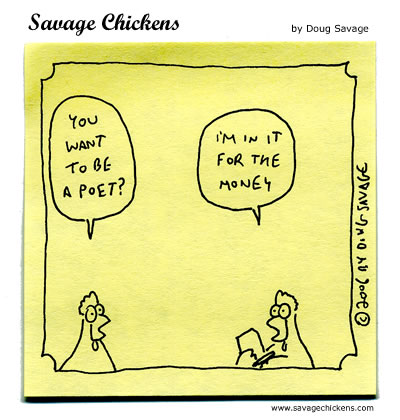
With tax day approaching as well as National Poetry Month, I thought I'd take a look at money from a poet's perspective.
I’m reading a book called The Gift: The Gift: Creativity and the Artist in the Modern World by Lewis Hyde that discusses the value of art and literature in our culture. As artists, sometimes our work brings us great financial rewards, sometimes it doesn’t. Money doesn’t validate one’s art, just as not making money shouldn’t diminish your art. Art is art. Poetry is poetry. Words and the act of writing make us richer as people.
It’s difficult in America when it is suggested through various outlets that rich=better. Lifestyles of the Rich and Famous began airing when I was a teenager. Oh the beautiful yachts, the enormous mansions, but you can’t look inside someone’s soul to see if it’s speckled in gold. You can’t see what happens when the privacy fence is shut and if what’s going on in the house is anything you’d want to be a part of. Rich does not necessarily equal good or happier, though I do believe money can allow you more freedom if you know how to use it (both freedom and money).
I also don’t believe that rich=evil, as there are some incredible honest, good, and generous wealthy people in the world who I am quite thankful for. However money can be what holds one back—too many things to care for, too much insurance, too many worries, overspent, overinvested, overwhelmed, overworked.
I’m going to share a little about how poetry and money works for me. Occasionally, I do get a little down on myself when I see my writing life as the job that brings in the least amount of cash in the family. When this happens, I have to remind myself that riches sometimes come in other forms. Again, this goes against what our current society may want you to believe. I have to remind myself that while sometimes I lack in cash coming in, I’m rich with time. I'm rich in time with my family and time with my writing.
I remind myself that I made a choice to be a full-time writer. I chose the writing life because it feels like what I need to do. Sometimes I question the “why,” but I still write, even when it doesn’t make sense all the time (or doesn't make money all the time). I remind myself that sometimes money does come in from poetry. When that happens, I am thankful. When it doesn’t, I am hopeful. Between hope and thanks, I try to stay centered and continue on what matters which is the writing. I’m a big believer that everyone should be doing something they love to do, something you’d do even if no one paid you for it. For me, poetry and writing is that thing.
One thing I do is keep a separate writing checking account. Money I make from poetry goes into this account to fund other poetry things—this can be contest fees, subscription fees, books, or donations to small presses and poetry organizations. I try to keep the poetry money circulating around and always try to have enough so if something comes up poetry related (a workshop, a conference, a reading, a book, etc.) the money is there to pull from.
One way I generate a little income is work with other poets. I do poetry critiques and manuscript consultations. I create packets of writing exercises to send to them and when they have written their poems, they send them back to me for feedback. I like this because the act of creating a packet that will spark a new poem feels like a way to add more good into the world. It’s also satisfying to me so read the completed poems. To give back to the poetry world, I donate some of this money back into the poetry world. It’s not a huge amount, but it’s something that I believe in.
As I’ve said, I’ve never had "evil" attached to money, but I have had fear (the fear of being broke!) And I’ve misspent, misspoken, misinvested, mistrusted, misused money and still, here I am. I remind myself money comes in to my life from unexpected places and I no longer have to pin emotions onto money, but see it for what it is—a way to help others, a way to help myself, and a way to help my family. I remember being younger and making a birthday wish “to be rich,” now my wishes are for “health and happiness for myself and everyone around me.” Money is not status or security. It took me most of my twenties (of making money) to realize that while money is helpful to have, it doesn’t equal my happiness, that it seems has to be there on its own.
And while it may sound as if I have it all figured out, I don't. I have to practice. I have continually ask myself if buying X will improve the quality of my life. I have to remind myself that money doesn't equal my happiness. I look around and notice what I do have instead of rolling my eyes at what I don't.
It's still the occasional shadow looming at my office door, but I no longer run to it with open arms when it tells me it can give me what I want. I no longer say yes when it invites itself into my day. I can tell it "I've learned to value time, the value of my time." I ask it to explain itself more often and no longer take what it gives me. And I no longer call it Sir, Mister, or Miss. I say thank you, then roll it up, and slide it into the bank for when I need it most.
my 2 1/2 cents.
